

Industrial adhesives are revolutionizing manufacturing by delivering solutions that enhance efficiency, reduce material waste, and drive product innovation across countless sectors. These versatile bonding agents form the backbone of more innovative production strategies, offering the ability to join materials in ways previously impractical or impossible. In particular, specialty solutions like Hot Melt Adhesive by NXT Level Packaging have set new standards for manufacturing in industries seeking speed, precision, and reliability in bonding applications.
As global industries shift toward lighter, stronger, and more sustainable products, industrial adhesives play a central role in these advancements. By integrating advanced chemistries, manufacturers realize benefits such as faster assembly times, improved product lifecycles, and greater design freedom. These innovations also support manufacturers in reducing their environmental footprint, marking a significant shift in how businesses select materials and design end products.
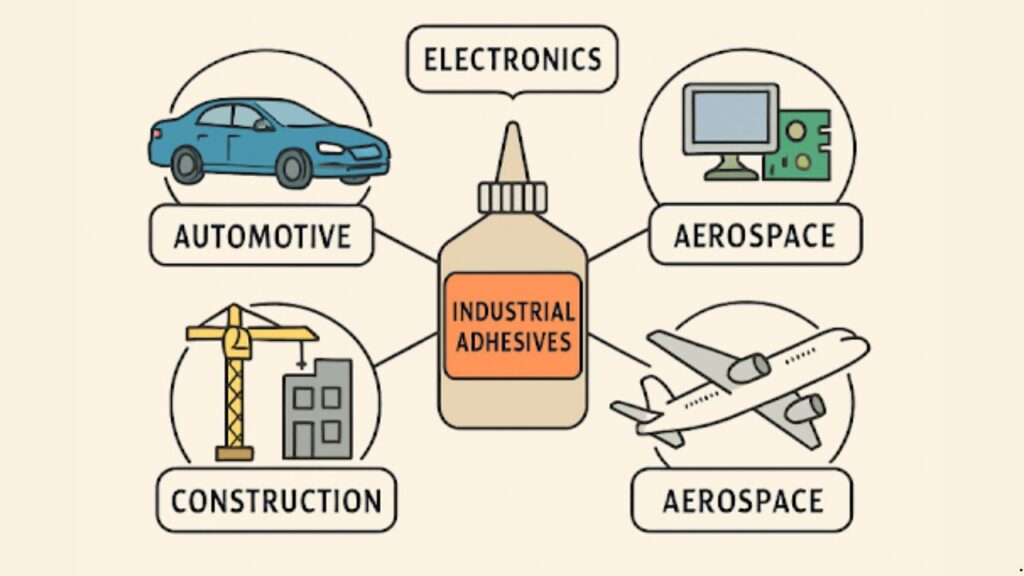
The adaptability of modern adhesives ensures that industries ranging from automotive to electronics consistently find tailored solutions that meet increasingly demanding requirements. Ongoing research and cross-industry collaborations are pushing the boundaries of what adhesives can achieve, with manufacturers regularly adapting to advanced formulations that deliver both functional and sustainability benefits.
This article examines the cutting-edge applications and transformative impact of industrial adhesives in key modern manufacturing sectors, highlighting how these developments are reshaping traditional processes and driving the next era of industrial excellence.
Automotive Industry
Automotive manufacturers have adopted industrial adhesives to meet the dual demands of reducing vehicle weight and enhancing occupant safety. Advanced epoxy structural adhesives, for example, replace traditional welding or mechanical fasteners in many new car models. This allows automakers to bond lightweight materials, such as carbon fiber and aluminum, efficiently—delivering significant improvements in fuel economy and, consequently, lower greenhouse gas emissions. BMW’s i-Series famously utilizes high-strength epoxy adhesives in carbon fiber chassis construction, helping achieve a 30% reduction in weight. Meanwhile, Tesla integrates polyurethane adhesive systems within its gigacast body designs for greater structural integrity and energy efficiency, as reported by Reuters.
Electronics Manufacturing
Miniaturization and increasingly complex device designs in electronics manufacturing have made adhesives indispensable. Beyond merely joining components, modern adhesives provide crucial functions such as electrical insulation, thermal management, and environmental protection, helping manufacturers implement strategies for streamlining your product manufacturing. Conductive adhesives, commonly used for attaching sensors and displays, maintain efficient electrical pathways across flexible and wearable devices that require thin, lightweight, and compact constructions. Robust encapsulants and conformal coatings, achieved with tailored adhesive chemistries, offer resistance to moisture and dust, enabling the development of longer-lasting, high-reliability electronics even in demanding conditions.
Aerospace Applications
Extreme operating environments necessitate that aerospace adhesives perform at the highest levels of strength and reliability. Specialized adhesives bond dissimilar materials—such as aluminum, composites, and titanium—while simultaneously reducing total airframe weight by eliminating the need for heavy fasteners and rivets. These substantial weight reductions, combined with the improved fatigue and stress distribution provided by adhesive bonding, result in fuel savings and increased payload flexibility. Aerospace firms are also exploring the innovative uses of cartridge heaters in aerospace engineering to further enhance efficiency, passenger safety, and aircraft longevity.
Construction and Infrastructure
The construction industry relies on high-performance adhesives and sealants for maintaining structural integrity, promoting energy conservation, and ensuring sustainability. Energy-efficient building envelopes rely on advanced sealants to prevent air and water infiltration around doors, windows, and expansion joints. Innovative adhesive solutions are increasingly preferred for wall panel assembly, brickwork, and flooring, enabling faster installations and improved long-term performance of structures. High-strength bonding between concrete, metal, and insulation panels also increases durability and reduces ongoing maintenance requirements.
Medical and Biomedical Fields
Cutting-edge adhesives are revolutionizing surgery and wound care in medicine, with formulations designed for biocompatibility, flexibility, and rapid curing even under challenging conditions. One standout example is AsparaGlue’s surgical adhesive, which employs water-activated alpha-lipoic acid polymerization. It addresses the need for secure, elastic bonding suitable for both internal and external tissues, and it’s available in user-friendly spray, patch, and powder forms. These biocompatible adhesives not only streamline complex surgeries but also accelerate patient recovery and reduce post-operative complications. More information can be found on AsparaGlue’s official website: AsparaGlue.
Sustainable and Bio-Based Adhesives
Sustainability mandates are driving the development of adhesives derived from renewable resources, targeting sectors such as automotive and footwear that have historically relied on petrochemical materials. Henkel AG’s Loctite bio-based polyurethane adhesives, for instance, contain over 50% renewable content and meet stringent European Union Green Deal targets. These next-generation adhesives provide robust bonding for thermoplastic elastomers while significantly reducing volatile organic compound (VOC) emissions and overall environmental impact, underscoring the global transition toward greener manufacturing.
Innovative Adhesives with Sensing Capabilities
The emergence of innovative adhesives demonstrates how industrial bonding technologies have now transcended traditional functions. Innovative adhesives are engineered to incorporate sensor elements within their formulation, allowing real-time monitoring of stress, strain, and environmental factors in bonded joints. This breakthrough enables predictive maintenance in sectors such as aerospace and automotive, reducing the risks associated with bond failure by alerting operators to performance changes before issues escalate. The data-driven insights these adhesives offer mark a significant leap forward in manufacturing safety, quality assurance, and operational efficiency.
Conclusion
Industrial adhesives are integral to the ongoing transformation of manufacturing, underpinning advances in design, sustainability, and product functionality across industries. From lightweight electric vehicles to life-saving medical devices and energy-efficient buildings, adhesives are shaping a future defined by innovation and operational excellence. As R&D continues to develop new adhesive technologies, their role within high-performance manufacturing environments is poised to grow—marking a new era of connected, sustainable, and intelligently engineered products.