
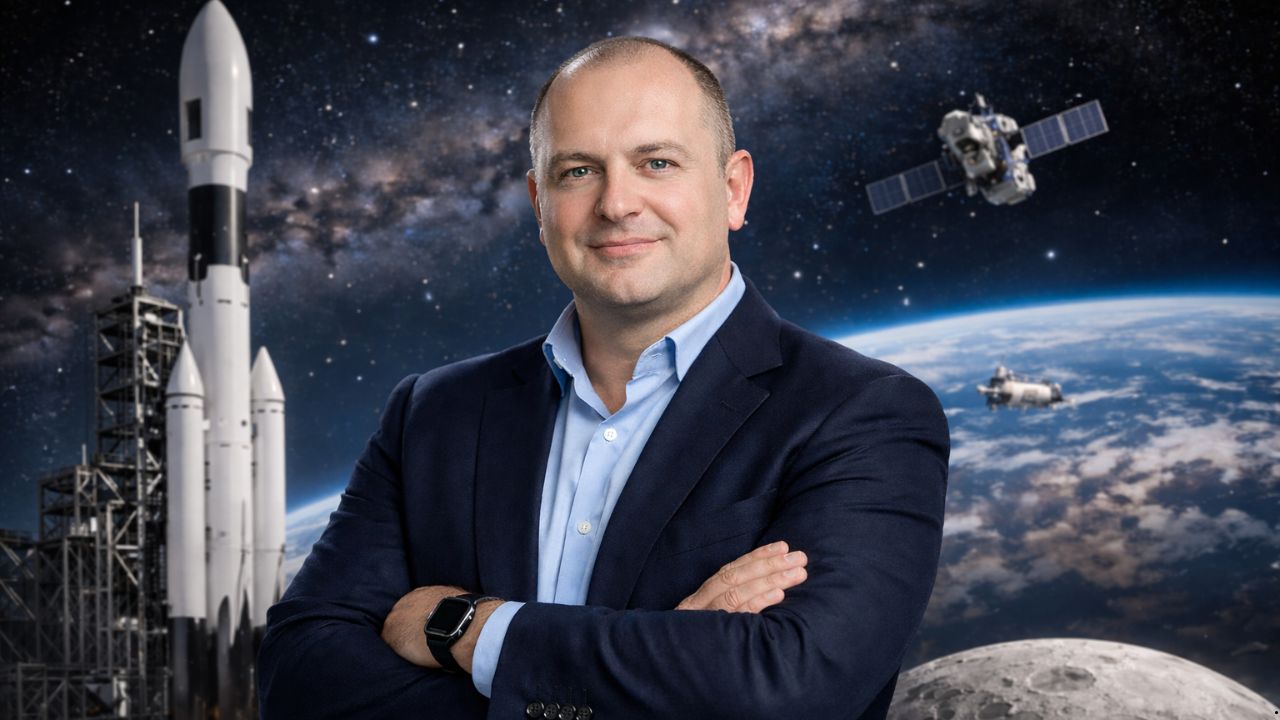
Growing up in Zaporizhzhya, Ukraine, in the late 1970s, young Maxym Polyakov watched his parents head off to work at Hartron, a Ukrainian rocket company. Their evening conversations about engineering challenges and rocket systems planted seeds that would eventually grow into a passionate career spanning information technology and aerospace innovation. Today, Max Polyakov stands as a prominent figure in both sectors, bridging the gap between digital solutions and space exploration.
Early Years and Education
Born in 1977 in what was then the Ukrainian Soviet Socialist Republic, Polyakov grew up surrounded by technical discussions. His parents were both engineers, which meant the dinner table often turned into an informal classroom. This environment naturally shaped his interests and career trajectory.
Polyakov pursued higher education at Dnipro University, where he focused on economics and technology. He completed his undergraduate studies in 2001, but his academic journey did not stop there. By 2013, he earned his doctorate degree in International Economics. His doctoral research examined how information paradigms influence global economic systems, a topic that would prove relevant to his future business ventures.
Breaking into Technology
His journey reflects many of the basic steps to become an entrepreneur outlined for aspiring business founders. The company specialized in software outsourcing, creating custom solutions for international clients. This initial experience taught him valuable lessons about managing development teams, understanding client needs, and navigating the complexities of cross-border business relationships.
The real turning point came in 2005 when Polyakov partnered with British entrepreneur Bill Dobby to establish IDE Group. Based in Edinburgh, this collaboration produced multiple successful projects. The partnership resulted in Cupid, an online dating platform that would eventually become one of their most recognized achievements. They also developed other ventures including Maxymiser, a website optimization tool, gaming company Murka, and analytics platform HitDynamics.
Expanding Business Horizons
By 2006, Max Polyakov recognized an opportunity in the Ukrainian market. He launched several aggregator websites designed specifically for local consumers. These platforms, including comparison sites and automotive search engines, filled a gap in the Ukrainian digital landscape. The projects established offices in major Ukrainian cities like Kyiv, Dnipro, Kharkiv, and his hometown Zaporizhzhya.
As the portfolio grew, Polyakov and his partners began strategically selling their successful ventures. HitDynamics found a buyer in Hitwise, demonstrating the commercial viability of their business model.
In 2010, Cupid achieved a significant milestone by listing on the London Stock Exchange. Industry observers recognized it as the fastest-growing technology project the following year. By 2012, Cupid reached impressive financial metrics with a market capitalization exceeding two hundred million dollars and substantial annual revenue.
That same year, Polyakov founded Renatus, a mobile gaming company developing applications for major platforms including Apple Store, Google Play, Facebook, and Amazon. He also relocated to Silicon Valley, where he co-founded Noosphere Venture Partners, a venture capital fund focused on technology investments.
In 2015, technology giant Oracle acquired Maxymiser, another validation of the quality and market demand for Polyakov’s ventures.
Turning Toward the Stars
The year 2015 marked a pivotal shift when Max Polyakov invested his attention and resources into space technology. Drawing on his IT background, he founded EOS Data Analytics, an American company with operational offices in Ukraine. The platform analyzes satellite imagery, primarily from Earth Remote Sensing satellites, providing valuable data for planet monitoring.
EOS Data Analytics quickly gained traction. Hundreds of government agencies, commercial enterprises, and educational institutions began utilizing the platform’s services. In 2019, the company won a competitive tender for the World Bank’s Land Transparency program, which received support from the European Union.
Aerospace Ambitions
Polyakov’s space technology interests expanded in 2017 when Noosphere Ventures acquired Firefly Systems, an American aerospace startup facing financial difficulties. Founded in 2014 by engineer Tom Markusik, who previously worked at SpaceX, Virgin Galactic, and Blue Origin, the company had ambitious plans but lacked adequate funding.
After the acquisition, Max Polyakov and his team rebranded the company as Firefly Aerospace. They retained the intellectual property, patents, and core mission of developing light and medium-class rockets named Alpha and Beta.
The transformation proved successful. In 2018, NASA selected Firefly as a participant in its lunar exploration program, awarding contracts valued at billions of dollars. Additional partnerships followed, including an agreement with Aerojet Rocketdyne, a former Boeing division.
By late 2019, Firefly completed successful test firings of first-stage and second-stage rocket engines. The company also established collaboration with the United States Air Force through the Orbital Services Program. By 2020, Firefly secured additional launch contracts and achieved necessary certifications, transitioning from design phase to active development.
The first Alpha rocket launch occurred in September 2021, achieving successful first-stage ignition, liftoff, and supersonic speed.
Giving Back Through Education
Beyond commercial ventures, Max Polyakov invested in educational initiatives. In 2014, he helped establish the Noosphere Engineering School in Dnipro. The school provides young innovators with resources and laboratory space to develop their technical projects. Today, the institution operates divisions in multiple Ukrainian cities including Kyiv, Cherkasy, Rivne, and Zhytomyr.
In 2016, Polyakov founded the Noosphere Association, a nonprofit organization dedicated to promoting science and technology. The association organizes technical competitions and educational events, partnering with organizations like the World Air Sports Federation. Notable events include BestRoboFest, a robotics festival, and the Noosphere Vernadsky Challenge engineering competition.
The association also contributes to community development projects in Dnipro, including the renovation of Gagarin Park and ongoing restoration of the local planetarium.
Recognition and Impact
Throughout his career, Max Polyakov received recognition for his contributions. In 2009, he earned the “Entrepreneur of the Year” award in Scotland. The World Air Sports Federation granted him an honorary award in 2017 for improving sports scoring systems. In 2018, he received Ukraine’s “Man of the Year” National Prize for advancing space technology development in his home country.
From software outsourcing to satellite analytics and rocket development, Polyakov’s journey demonstrates how childhood inspiration can evolve into meaningful innovation. His story reflects the possibilities that emerge when technical education, entrepreneurial vision, and commitment to progress align.