Key Takeaways
- AI-based image upscaling enhances image resolution and detail without introducing artifacts.
- These techniques are widely used in photography, gaming, and television to improve visual quality.
- AI upscaling offers significant advantages over traditional methods, including better texture preservation and handling of low-quality images.
Table of Contents
Introduction
The demand for high-quality visuals is growing rapidly. Whether it is social media, professional photography, gaming, or streaming services, crisp and clear imagery is crucial in the digital world. AI-based image upscaling has emerged as a cutting-edge solution for increasing image resolution and enhancing detail with precision. New deep learning techniques and smarter algorithms now allow users to enhance photo 4K and recover significant visual details from low-resolution sources.
Unlike traditional methods that often fail to preserve image integrity, AI upscaling leverages advanced neural networks. These models identify and reconstruct details with remarkable fidelity, bridging the gap between low and high-resolution content. As a result, images once deemed unusable for large displays or professional prints can now be revitalized for a modern audience.
High-resolution images are crucial in media-rich environments. As devices and screens improve, there is a growing need for scalable solutions that go beyond simple upscaling techniques. AI does not just fill in missing pixels; it intelligently predicts details, offering a level of realism previously unattainable with conventional approaches. This is especially transformative for historic photos, personal memories, and user-generated content.
The speed at which AI models can process and upscale visuals has made them accessible and widely available across different industries. From personal apps to enterprise solutions, AI upscaling is shaping a new standard for digital imagery. For more on how machine learning is reshaping visual technologies worldwide, you can visit The New York Times: How AI Is Changing Photo Restoration.
How AI Upscaling Works
At the core of AI upscaling are deep learning models, specifically convolutional neural networks, that learn the relationships between low- and high-resolution image pairs. These algorithms are trained on extensive datasets, enabling them to recognize patterns, textures, and features across different scenarios. When an image is processed, the AI model analyzes each pixel’s context, extrapolates missing information, and generates a higher-resolution output that appears smooth, consistent, and true to the original.
The process does not simply enlarge pixels. Instead, the AI reconstructs finer details such as hair strands, background foliage, and facial features, even when the original data is severely limited. This level of detail is achieved through iterative improvements during training, allowing the AI to generalize well across a broad spectrum of content types. Today, these models run efficiently on consumer hardware, making advanced upscaling accessible to everyone.
Advantages Over Traditional Methods
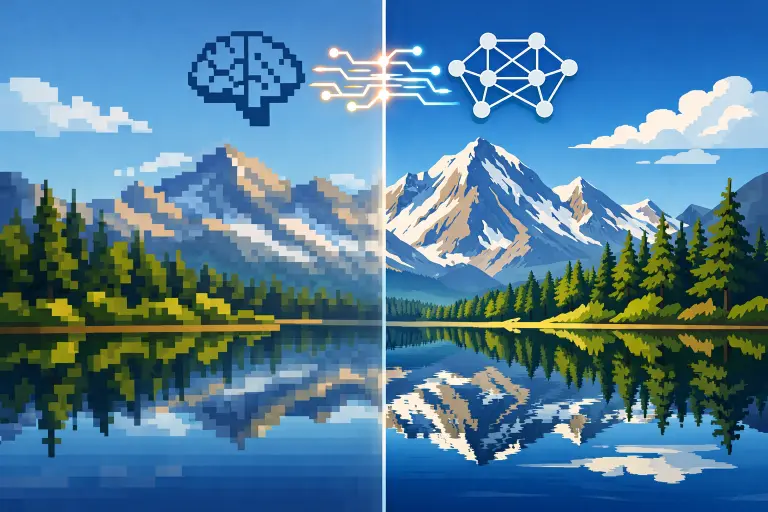
Traditional upscaling techniques, such as bicubic or nearest-neighbor interpolation, often introduce undesirable effects, such as blurring and loss of detail. These methods lack the sophistication to recognize real-world textures, usually resulting in soft or artificial-looking results. AI-based upscaling, on the other hand, produces images that are significantly sharper and more natural because the models can infer high-frequency textures and subtle gradients.
Another advantage lies in artifact handling. AI models are trained to avoid creating halos, ringing, or noise commonly found in conventionally upscaled images. This makes AI upscaling ideal for both archival restoration and content repurposing, where maintaining authenticity and clarity is paramount. The result is a more visually pleasing and structurally intact image, suitable for professional reproduction or high-resolution displays.
Applications in Photography
Modern photographers and creators are increasingly leveraging AI upscaling to restore, enhance, and repurpose images, both old and new. For example, photo editing suites like Adobe Photoshop’s Super Resolution feature use machine learning to quadruple a photo’s pixel count while preserving critical image integrity. This is especially valuable for producing enlargements, archival prints, or digital portfolios from older digital cameras and scanned analog photos.
AI upscaling is also a powerful tool for photo restoration projects. It allows individuals and institutions to recover cherished memories, family photos, and historical documents that may only exist in low-quality or damaged formats. These enhancements are now routinely applied by professionals and hobbyists alike, making the technique an essential part of modern photographic workflow. For deeper insight into these academic advances, the article How Artificial Intelligence Is Reviving Lost Art offers valuable information.
Impact on Gaming
The gaming industry has been quick to adopt AI upscaling for its ability to improve graphics quality while preserving performance. Next-generation consoles and gaming PCs use AI-based tools to upscale lower-resolution textures and models, delivering more immersive, higher-fidelity visuals without requiring additional processing power. Technologies like NVIDIA’s DLSS and AMD’s AI upscalers are revolutionizing in-game visuals, ensuring smoother experiences even at high resolutions.
For developers, this means they can build games optimized for a range of hardware capabilities. High-quality graphics are no longer limited to the most expensive hardware, enabling broader access and fairer competition among players. This approach extends the lifespan of existing games and hardware, contributing to sustainability and user enjoyment.
Enhancing Television Viewing
Modern televisions increasingly rely on AI upscaling to bring high-definition quality to older or low-resolution content. Whether streaming vintage films or live sports, AI-enhanced processors can analyze each frame in real time, filling in missing information and reducing the blockiness or artifacts that plague traditional upscaling. The result is a more cinematic, immersive home-viewing experience, regardless of the original content’s source quality.
This technology also benefits live broadcasts and streaming services by dynamically adjusting to different broadcast standards, helping ensure consistent quality across various genres and platforms. As 4K and 8K TVs become more popular, AI upscaling ensures that every visual makes full use of these advanced displays’ capabilities.
Future Prospects
The future for AI-based image upscaling looks bright, boosted by ongoing research in machine learning and greater availability of high-quality training data. Researchers are working to improve the models’ accuracy, speed, and generalization across more image types and resolutions. Future upscaling tools will likely offer real-time processing for ultra-high-definition content, expand to video enhancements, and integrate seamlessly into everyday devices and online platforms.
Cross-industry collaborations may lead to innovative applications in fields such as medical imaging, satellite photography, and virtual reality, where clarity and precision are critical. As AI algorithms become more transparent and explainable, users can expect even greater trust in automated upscaling, further solidifying its role in digital content creation and consumption.
Conclusion
AI-based image upscaling techniques have fundamentally changed how we think about digital imagery. By providing substantial improvements over traditional upscaling, AI now drives quality and accessibility in photography, gaming, and television. As technology advances, it will continue to play a vital role in delivering clearer, more lifelike visuals for both personal and professional use.