

Schools and colleges usually don’t have a shortage of success stories. The real problem is that those stories live everywhere. One team posts student awards on Instagram. Alumni news, athletic achievements, and academic archives are often scattered across different departments, often inconsistently. This fragmentation makes it difficult to maintain a unified and complete picture of institutional success.
That’s why more organizations are rethinking how they present achievement. A single, well-managed recognition hub does more than celebrate people. It helps with admissions, alumni relations, donor confidence, internal culture, and even recruiting. Prospective families want proof that students thrive there. Alumni want to see that accomplishments are remembered. Staff want a system they can actually maintain.
Why a Single Recognition Space Works Better
When achievements are spread across departments and platforms, visibility drops fast. A post gets likes for a few days, then disappears. A printed plaque looks nice in a hallway, but only for people who happen to walk by it. A legacy page on the website may exist, but if nobody updates it regularly, it stops being useful.
A centralized recognition space solves several problems at once:
- It creates one reliable place to find honorees, awards, milestones, and notable career outcomes.
- It makes recognition easier to maintain across graduating classes and decades of alumni history.
- It provides marketing, admissions, and advancement teams with easily accessible, ready-to-use content.
- It helps institutions present achievement as part of their identity, not as scattered announcements.
Recognition systems are often undervalued until someone asks where to find all award winners in one place. If answering that requires checking multiple websites, trophy cases, and outdated files, your system needs an upgrade.
What the Best Systems Actually Include
The strongest showcase systems are not just lists of names. They give context. A good recognition hub should help visitors understand who was recognized, why it matters, and how that achievement connects to the institution.
In practice, that usually means including:
- Search and filters by graduation year, department, award type, sport, or area of achievement
- Photos, short bios, and plain-language descriptions of awards or accomplishments
- Space for both current student recognition and alumni milestones
- A format that works on phones, tablets, laptops, and public displays
- A simple internal process for updates, approvals, and corrections
This last point is often ignored. Avoid systems that depend on complicated spreadsheets or a single staff member, as these are difficult to keep up-to-date. Instead, choose a simple process that your team can easily manage.
Where a Digital Display Fits In
A lot of institutions still rely on physical boards, glass cases, framed portraits, and engraved plaques. Those can still play a role. They carry tradition, and in the right setting they look great. But they don’t scale well, and they don’t help much with accessibility or ongoing updates.
That’s where a digital wall of fame becomes useful. It allows a school to combine current recognition with historical records in one system that can be updated without reprinting materials or replacing hardware every semester. It also gives schools flexibility. The same content can appear on a touchscreen in a student center, on a monitor outside the gym, and on a website page used by families and alumni.
For institutions with a long history, this solves a very practical issue. Recognition programs tend to grow unevenly over time. Different departments use different formats. Some years have lots of documentation. Others have almost none. A digital system gives you a way to standardize presentation without pretending every record is equally complete.
Why Physical Displays Alone Usually Fall Short
Traditional displays still have value, especially in places where ceremony and legacy matter. A lobby installation, championship wall, or donor corridor can make a strong first impression. But as the only recognition system, physical displays create limits pretty quickly.
Here’s what tends to happen:
- Without a digital wall, space runs out fast
- Updates get expensive
- Old honorees are removed to make room for new ones
- Visitors can’t search or filter anything
- Off-campus audiences never see it
- Information ages badly when job titles, awards, or affiliations change
Schools often don’t realize these limitations until they need to use their displays for more than just a centerpiece. Whether for admissions tours, alumni relations, or career services, a static display quickly struggles to handle these broader, evolving needs.
How to Organize Student and Alumni Recognition Together
Combining student and alumni achievements in one place works best when the structure is clear from the start. If everything is thrown into a single feed, the result feels messy. Visitors need obvious ways to browse by audience and purpose.
A practical structure usually includes:
- Student awards and honors
- Athletic achievements
- Academic competitions and scholarships
- Alumni career milestones
- Distinguished alumni or community impact awards
- Historical archives and legacy recognition
That doesn’t mean every category needs equal detail. Some schools have rich alumni data and limited student records. Others have the opposite. Start with what is documented well, then expand. Trying to launch with a perfect archive often delays the project for months, sometimes longer than anyone wants to admit.
Decide early how names, graduation years, departments, award titles, and photos will be entered. Consistency is what makes search, filters, and future updates manageable.
What Makes a Hall of Fame Display Effective
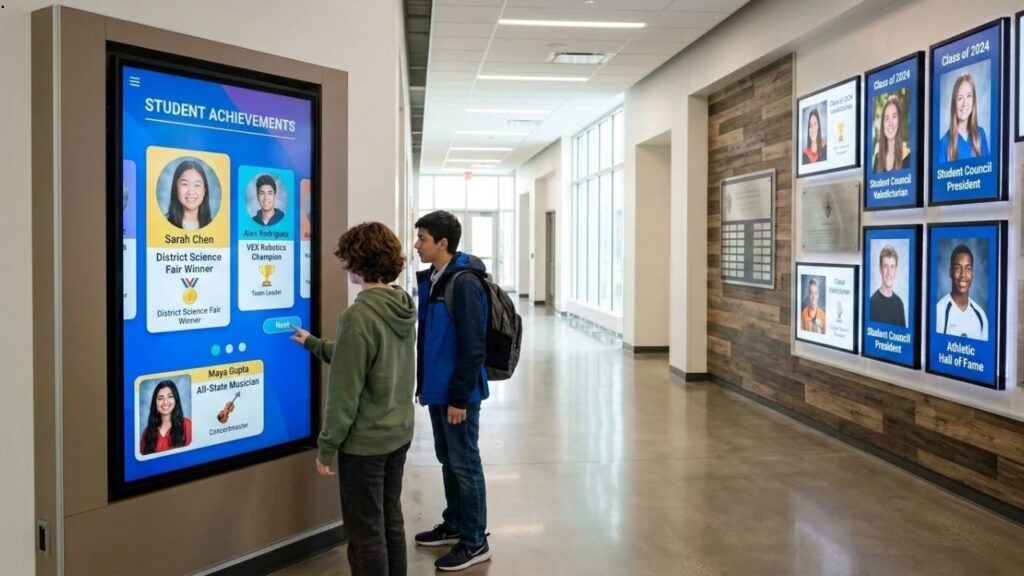
A hall of fame display works when it feels curated, not crowded. People should be able to understand the institution’s standards for recognition within a few seconds. Who gets featured? For what reasons? How is the content organized?
The better installations usually share a few traits:
- Clear categories and eligibility criteria
- Strong visual hierarchy, with names and achievements easy to scan
- A mix of recent and historical honorees
- Photos and supporting details that add context without turning each entry into a full biography
- A straightforward nomination or update process behind the scenes
It also helps to think beyond athletics. Many schools hear “hall of fame” and immediately picture sports, but institutions can recognize leadership, arts, public service, entrepreneurship, military service, research, and long-term community impact. If the goal is to represent the full strength of the institution, the display should reflect that.
The Operational Side Matters More Than the Screen
The screen, software, or hardware gets attention because it’s visible. The maintenance process is what determines whether the project lasts.
Before launching, schools should answer a few basic questions:
- Who owns updates?
- Who approves submissions?
- How often is content reviewed?
- What standards apply to photos and bios?
- What happens when information changes or a record needs correction?
These are not glamorous questions, but they save a lot of trouble later. I’ve seen recognition projects stall because nobody defined ownership after launch. The display looked polished on day one and slowly became a time capsule.
Keep management simple, assign one team to oversee the system, use a standard form for department submissions, and have one person review entries before publishing. Simple processes are always more effective than complex ones.
Choosing the Right Approach for Your Institution
The best approach depends on your goals, audience, and how much content you already have. A smaller private school may need a focused recognition hub with a few categories and strong visuals. A large university may need a searchable archive that spans departments, athletics, and alumni relations.
What usually makes sense:
- If your current recognition is mostly physical, start by digitizing core honorees and award categories
- If your content already exists online but is scattered, consolidate it into one structured system
- If admissions and advancement need better storytelling tools, prioritize searchable profiles with photos and concise bios
- If campus foot traffic matters, connect the online experience to an on-site screen or kiosk
The common mistake is treating this as a design exercise only. It’s really a content and operations project with a public-facing front end.
The Best Way to Do It
If the goal is to showcase student and alumni achievements in one place, the best option is a centralized digital system supported by a clear content process and, where appropriate, paired with physical on-campus displays. That gives institutions reach, flexibility, and a way to keep recognition current without rebuilding the project every year.
The schools that do this well usually aren’t doing anything flashy. They’ve just made smart decisions about structure, ownership, and accessibility. That tends to age better than a trophy case that ran out of room five years ago.