
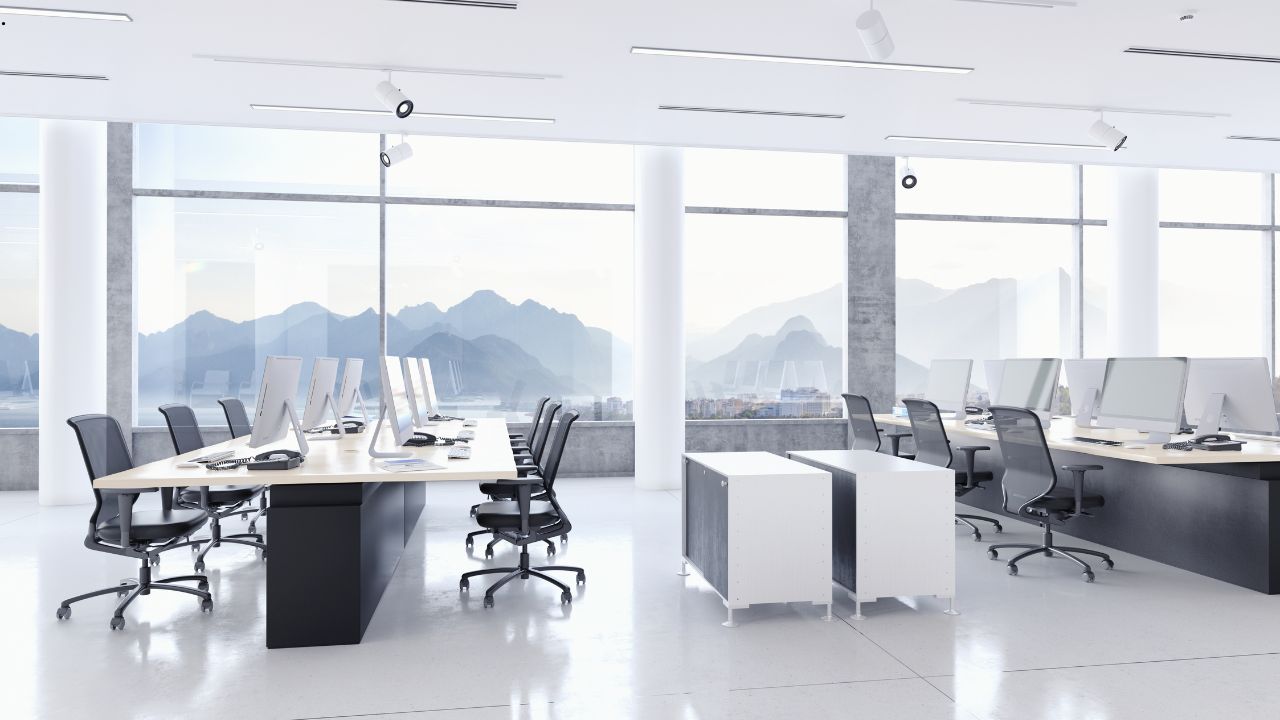
It is safe to say that office design has evolved significantly over the past century. Even without knowing the first thing about office design and architecture, this would be an easy statement to extrapolate – if only for the fact that our working world has changed so significantly too. We come from a world of pen and paper, banks of typists and thrumming industrial floors; today’s world is near-unrecognizable, comparatively.
The changing office, then, reflects changes in technology, workplace culture and employee expectations that have occurred in that breakneck century of industry, technology and development. Today, hybrid working and a more direct approach to employee wellbeing rule the roost, with office design priorities shifting to meet this new specifics. As such, the modern workplace is a very different place to that early pen-and-paper environment. But what exactly has changed – and how did we get here?
1. From Traditional Offices to Open-Plan Layouts
The most dramatic shift in office layout occurred somewhat recently, with a foundational change in the way office layouts were approached. Between the 1960s and the 1990s, the cubicle ruled the roost. Workers were compartmentalized, and those compartments were hierarchical in nature; the lower rungs of the career ladder would have boxy environments in the middle of the floor, while management had private offices on the outskirts.
This cubicle design, by the 1990s, was inspiring a great deal of cynicism – tracked well by the emergence of countercultural media depicting the cubicle as a loss of identity (see Office Space, The Matrix, Fight Club). This cynicism, coupled with a new globalist outlook on business, led to a new Millenium of expanded, open-plan offices that aimed to improve communication, collaboration, and worker freedom.
2. The Rise of Employee-Centric Design
It was at this point that organizations began recognizing the true impact of workplace environments on key employee metrics – chief amongst which are arguably productivity and retention. With the understanding that employee happiness and comfort charted with productivity, new office designs shifted toward employee wellbeing.
Employee wellbeing is a nebulous concept, but one that makes the most sense when approached from the perspective of comfort. Natural light is a mental health positive, for instance. Managing comfort levels is a multi-disciplinary thing, being that it takes in everything from installing ceiling tiles to control acoustics to supplying ergonomic furniture for long-term musculoskeletal health.
3. Technology Has Reshaped the Modern Workplace
It is impossible to talk about office design without acknowledging advances in technology. High-speed internet connectivity and a newfound reliance on cloud-based software have made smart office systems all the more important, continuing a trend of reduced reliance on fixed workstations and enabling more flexible working arrangements for a newly hybrid workforce.