Table of Contents
A vision for roads that inspire
If you’ve ever driven through a British town or city, you’ve probably noticed something about our roads. It’s not the potholes, although those are a depressingly regular feature. It’s not the congestion, or the pollution, or the noise. It’s something more fundamental: the way our roads look. The relentless greyness, the endless expanse of tarmac, the utter lack of character or charm. Our roads are, more than anything else, functional spaces. They are utilitarian carriages designed to move traffic as efficiently as possible with minimal disruption and – this is the key – with zero aesthetic consideration. Safe enough, yes, but also profoundly uninteresting. Lacking the visual richness, tactile variety, and sense of place that once made British streetscapes so distinctive.
The mission for Quicksetts is simple: “Make Britain’s Roads Great Again”. This is neither sloganeering nor rose-tinted nostalgia. It is a recognition that regenerating our roads is not just about filling potholes and resurfacing carriageways. It’s about reclaiming our streets as spaces of civic pride, beauty, and functionality. It’s about acknowledging that the built environment we live in directly shapes the quality of our lives – our sense of community, our safety, our wellbeing.
At the heart of this vision are Quicksetts: a game-changing surface-mounted block system that blends beauty, durability, and safety in ways no other product can. Where traditional road treatments have traditionally forced a choice between aesthetics or performance, Quicksetts does both. Where conventional methods treat roads as infrastructure, Quicksetts sees them as opportunities for place-making and community pride. This article will explore the revolution Quicksetts are leading in Britain’s roads and why it matters more than you think.
The problem: Functional but forbidding – the cost of ugly infrastructure
Before we can fully appreciate the power of Quicksetts, we need to understand the problem they solve. Britain’s post-war road design legacy has prioritised two things above all else: cost and speed. In the rush to rebuild and modernise, aesthetics were seen as a luxury. Roads were treated as purely functional infrastructure – problems to be solved with the cheapest, quickest solution possible.
Tarmac became the default surface for just about everything. It was cheap, quick to lay, and reasonably durable. What it wasn’t – and still isn’t – is beautiful, interesting, or contextually sensitive. Cobblestone setts, brick paving, and decorative surfacing were ripped out in favour of endless expanses of black asphalt. The rich visual language of British streetscapes – the patterns, textures, and colours that once gave each place its unique identity – was systematically eradicated.
The result has been a road network that is functional to a fault. Safe, yes, but uninteresting, lifeless, and in places actively hostile. And the cost of this functional approach is much greater than we care to admit. Here are just a few ways our ugly infrastructure is costing us:
Social impact: Ugly, characterless roads are places people avoid, not linger in. Streets that feel hostile and uninviting push people away. They discourage footfall, reduce local spending, and fragment communities. Civic pride and local identity erode when the public realm is neglected. Research shows consistently that well-designed, attractive streets encourage social interaction, support local businesses, and foster a sense of belonging. Ugly, poorly designed streets – no matter how “functional” – actively undermine community cohesion.
Safety impact: Monotonous road surfaces with poor visual cues are dangerous for drivers, pedestrians, and cyclists. Without clear demarcation between zones and uses, conflict is inevitable. Vulnerable road users – in particular those with visual impairments – struggle to navigate roads that lack tactile and visual variation. Traditional traffic calming measures like speed humps and speed bumps are often visually jarring and uncomfortable, breeding resentment rather than compliance. The result is roads that meet minimum safety standards but fail to create truly safe environments.
Environmental impact: Vast areas of dark tarmac contribute to the urban heat island effect. Absorbing solar radiation and radiating it back into the environment, they raise local temperatures, increase energy demand for cooling, and worsen air quality. Traditional road surfaces offer no ecological value whatsoever. They are impermeable, create no habitat, and contribute nothing to biodiversity. In an age of climate emergency, this is not just indefensible – it’s unsustainable.
The truth is that Britain’s roads have become functional but forbidding. They do their job, but that job is to be invisible. They do the minimum required to meet standards, but don’t do anything to improve lives. They are infrastructure, not place-making. And the cost of this functional approach – in lost civic pride, compromised safety, environmental damage – is huge.
The Quicksetts solution: Where beauty meets brawn
Quicksetts are a radical new approach to road surfacing that refuses to accept the false choice between aesthetics and performance. Developed by Jobling Purser, Quicksetts are a surface-mounted, high-strength concrete block system designed to offer unrivalled durability and aesthetic versatility.
The magic of Quicksetts lies in their design. Unlike traditional block paving that requires excavation and base preparation, Quicksetts are surface-mounted onto existing road surfaces using a high-strength adhesive. This dramatically speeds up installation and reduces disruption without compromising on structural integrity needed to withstand heavy traffic, including HGVs and buses.
The aesthetic game-changing that truly sets Quicksetts apart
Aesthetic versatility: Quicksetts are available in a wide range of colours, allowing designers to create just about any pattern or visual effect they can imagine. From subtle earth tones that complement historical architecture to bold, contemporary colour schemes that make a statement, the possibilities are endless. Patterns range from simple linear designs to complex herringbone layouts, concentric circles, radiating designs, and bespoke decorative features. This versatility means Quicksetts can be tailored to any context – from sensitive conservation areas to cutting-edge urban developments.
Tactile intelligence: One of Quicksetts’ most innovative features is their ability to create a tactile vibration when driven over. This is not a happy accident, but a deliberately engineered characteristic with multiple benefits. For drivers, the tactile feedback provides a gentle but effective reminder to slow down, making Quicksetts ideal for speed tables and traffic calming. For visually impaired pedestrians, the distinctive sound and vibration pattern created by vehicles crossing Quicksetts provides valuable auditory information about traffic movements. And for all users, the visual and tactile interest adds richness and engagement to the streetscape, transforming roads from monotonous corridors into exciting environments.
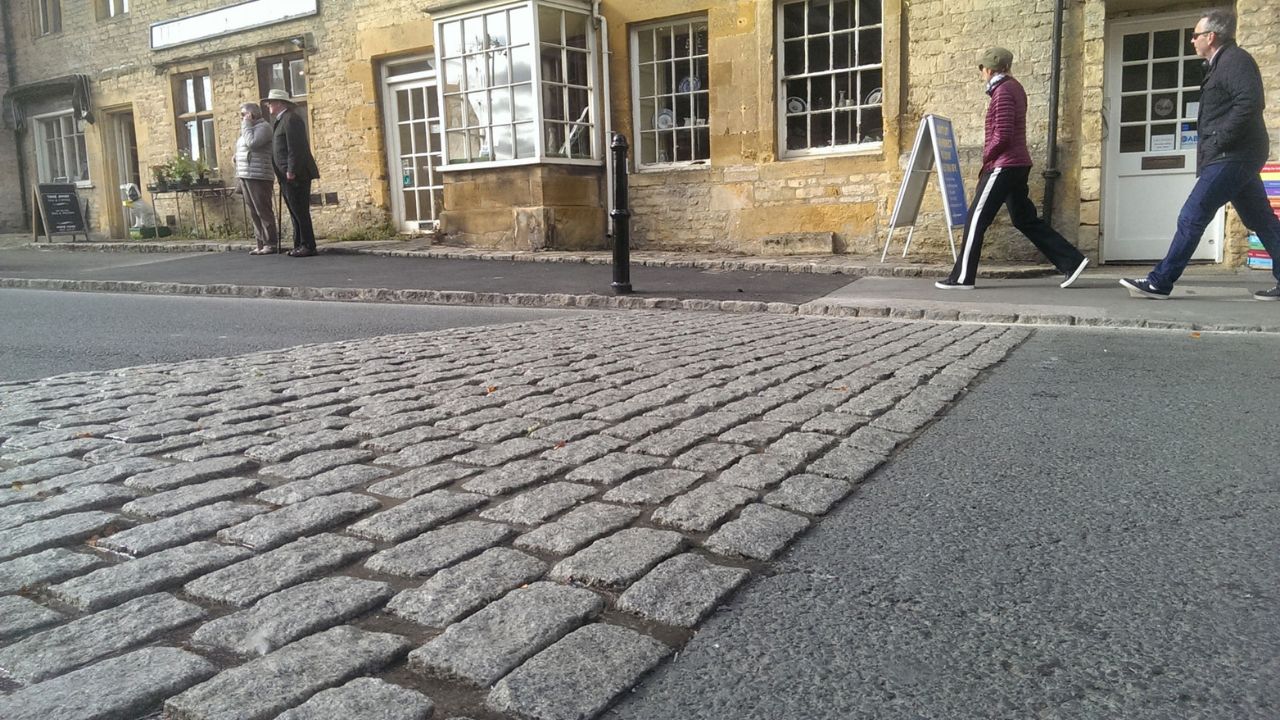
Context-sensitive design: Perhaps most importantly, Quicksetts enable truly context-sensitive design. In historical areas, they can mimic the appearance of traditional cobble setts, respecting architectural heritage whilst delivering modern performance. In shared spaces, they can define zones and create visual continuity without harsh barriers of kerbs and bollards. In new developments, they can establish a distinctive sense of place from day one, creating streets that feel established and valued rather than raw and temporary.
The beauty of Quicksetts is that they don’t just look good – they perform exceptionally well. The high-strength concrete blocks are engineered to withstand the most demanding traffic conditions, including repeated HGV and bus loading. The surface-mounted installation creates a monolithic surface that resists displacement and rutting. And the individual block format means that any damaged areas can be repaired quickly and invisibly by replacing individual units, rather than cutting out and patching large sections of surfacing.
Case in Point: Transforming Key Areas
The transformative potential of Quicksetts is best understood through real-world applications. Across Britain, forward-thinking councils, developers, and communities are using Quicksetts to reclaim their streets and create places of genuine distinction.
Town Centre Gateway: A typical town centre gateway is the transition point between a main road and a high street. Traditionally, this point is poorly defined, often marked only by a signpost and a change in speed limit. The unfortunate reality is that this lack of visual change often results in drivers failing to alter their behaviour, continuing at inappropriate speeds through the pedestrian-rich heart of town.
Imagine this same gateway transformed with coloured Quicksetts arranged in a decorative speed table pattern. The visual impact is immediate and unmistakable. Colours and patterns form a clear visual cue that you’re entering a different kind of space, one that requires different behaviour. The raised profile of the speed table naturally encourages speed reduction, with the tactile feedback reinforcing the visual message.
But while traditional speed humps are often resented as uncomfortable and punitive, the Quicksetts speed table is different. Beautifully patterned and integrated into the streetscape, it doesn’t feel like a tax or a warning – it feels like an attraction. The pattern could incorporate the town’s colours, or echo local architectural styles, creating a unique sense of arrival. Pedestrians benefit from a clearer, more defined crossing point, enhancing safety and accessibility, whilst the overall effect is to transform a non-place into a genuine gateway befitting the town centre beyond.
Public Square & Shared Space: In many British towns, public squares have been compromised by vehicle dominance. Delivery vehicles, personal cars, and other vehicles intrude into spaces that should be primarily pedestrian, creating conflicts and undermining the square’s purpose as a social gathering place. Traditional solutions – bollards, barriers, differential surface levels – often create visual clutter and can lead to accessibility issues.
Patterned Quicksetts offer an elegant alternative. By creating a cohesive surface treatment across the entire square, with subtle variations in colour and pattern to define different zones, Quicksetts can effectively neutralise the visual impact of vehicles while still allowing necessary access. Delivery vehicles, for example, can still reach a shop entrance, but it will be immediately apparent that they’re entering a pedestrian-priority space rather than driving on “its” road. Patterns can be designed to draw the eye towards focal points—a fountain, a statue, a historic building—creating visual coherence and a sense of place. The result is a square that feels unified and pedestrian-friendly while remaining functionally accessible.
Historic District: Perhaps the most sensitive and delicate application of Quicksetts is in historic areas, where any intervention must tread lightly to respect the architectural and cultural heritage of the environment. The traditional traffic calming measures in such contexts—garish speed tables, plastic bollards, modern road markings – often clash horribly with period architecture, creating visual pollution that detracts from the very heritage these measures are intended to protect.
Quicksetts enable a sympathetic approach to traffic calming that can enhance rather than compromise the historic character. By mimicking the appearance of traditional cobble setts or replicating historic paving patterns, Quicksetts can create traffic calming features that look as though they’ve been in situ for centuries. A series of Quicksetts rumble strips approaching a historic market square, for example, can provide effective speed reduction while appearing entirely in keeping with the surrounding architecture. The colours and patterns can be carefully chosen to complement local stone and brickwork, creating visual harmony and continuity. The result is a solution that works with the historic environment rather than against it, protecting both heritage and safety.
The Compelling Benefits: A Smart Investment
The case for Quicksetts extends far beyond aesthetics and place-making. When assessed against traditional road surfacing options, Quicksetts represent a genuinely smart investment that provides a multitude of benefits.
Sustainable: Durability is sustainability. Quicksetts’ exceptional longevity means reduced replacement cycles, lower material consumption, and a decreased whole-life environmental impact. The high-strength concrete blocks are engineered to last for decades, even under high traffic loads. Unlike tarmac, which degrades relatively quickly and needs regular resurfacing, Quicksetts maintain their structural integrity and appearance over the long term. This durability directly translates into lower carbon emissions, less waste, and a reduced environmental footprint over the asset’s lifetime.
Maintainable: One of the most frustrating aspects of traditional road surfacing is that repairs are always visible. A patched pothole never quite matches the surrounding surface, creating a patchwork appearance that’s a sign of neglect. Quicksetts eliminate this problem. Because they’re installed as individual blocks, if a damaged unit occurs it can be removed and replaced without any visible repair. The new blocks will match the existing surface perfectly, and the repair is invisible. This means roads can be maintained to a much higher standard without the visual degradation that traditional road repair work leaves behind. It also means that utility companies and other underground service providers can access services without leaving permanent scars on the road surface.
Aesthetic: The aesthetic transformation that Quicksetts make possible isn’t superficial – it’s fundamental to place-making and community pride. Attractive streets encourage footfall, support local businesses, and foster civic engagement. They signal that a community values itself and its public realm. Numerous studies consistently show that environmental quality has a direct impact on property values, economic activity, and social cohesion. By turning visual blight into visual assets, Quicksetts contribute to community wellbeing in measurable, meaningful ways.
Rapid & Resilient: The surface-mounted installation method means Quicksetts can be installed quickly and with minimal disruption. There’s no need for excavation or lengthy curing times. Roads can be closed, treated, and reopened in a fraction of the time it takes for traditional reconstruction. This rapid installation reduces inconvenience for residents and businesses, whilst also lowering installation costs. And despite the speedy installation, the result is exceptionally resilient – able to withstand HGV traffic, buses, and the most demanding loading conditions without degradation.
Tactile & Safe: The safety and accessibility advantages of Quicksetts are significant. The tactile feedback provides effective speed reduction without the discomfort and resentment associated with traditional speed bumps. The visual interest helps maintain driver attention and provides clear demarcation between different road zones. For visually impaired pedestrians, the distinctive sound of vehicles crossing Quicksetts provides valuable information about traffic movements. And the ability to create clearly defined crossing points and pedestrian priority areas enhances safety for all vulnerable road users.
When considered holistically, it becomes clear that Quicksetts are a solution that delivers exceptional value. The initial outlay may be higher than basic tarmac, but when you factor in the whole-life costs – durability, maintainability, and the broader social and economic benefits – Quicksetts represent a genuinely cost-effective solution.
Joining the Movement: How to Specify Quicksetts
Making Britain’s roads great again won’t happen by accident. It won’t happen without vision, commitment and action from those who plan, design, build and use our built environment. It will happen, one street at a time, if more local authorities, planners, architects, developers and community groups take the opportunity to transform their roads with Quicksetts.
Identify Opportunities
Look at your area with a critical eye. Where are the roads that are detracting from rather than adding to their setting? Which town centre gateways are bland and unmemorable? Which public spaces are blighted by the dominance of vehicles? Which historic or conservation areas are spoiled by poorly conceived traffic calming? All of these are candidates for road surface transformation with Quicksetts.
Consult the Experts
Jobling Purser’s technical and design team has over 25 years’ experience in specifying, designing and installing Quicksetts solutions in all sorts of contexts. Consult us early in the design process to optimise the design for maximum visual impact and functional performance. We can advise on colour, pattern design, installation methodology and integration with existing or adjacent surfaces. Our expertise will help ensure that your project realises its full potential.
Access the Resources
Jobling Purser has produced a comprehensive technical resource to help specify and install Quicksetts. The Quicksetts catalogue gives detailed product specifications, performance data, installation details and design inspiration. This is an essential resource for anyone who is involved in specifying or procuring road surfacing solutions. Download the catalogue to explore the full range of colours, patterns and product specifications, and see how Quicksetts can be tailored to meet your needs.
Make the Case
Transforming roads will require investment, and investment will require a business case. Build your case on the multiple benefits that Quicksetts can deliver: aesthetics, safety, accessibility, whole-life costs, place-making and community pride. Present Quicksetts not as a cost or a discretionary luxury but as a smart investment in community infrastructure with measurable returns. Demonstrate the benefits, build the case and make the case.
Start Small, Think Big
You don’t have to reinvent an entire town centre overnight. Start small: a single gateway feature, a short public square, a stretch of historic street. Show the difference that can be made, build support and create momentum for transformation on a larger scale. Success breeds success and visible improvements create demand for more.
This is what “Make Britain’s Roads Great Again” is all about. It’s not just a slogan; it’s a practical programme of incremental improvement, project by project, street by street, town by town. Quicksetts is the proven tool; what’s needed now is vision and commitment to use it.
Paving the Way Forward
Britain’s roads need not be grey, characterless and forbidding. The default approach to road design that has dominated the last 70 years or so: prioritise cost and speed of delivery over aesthetics and place-making; the same pavement solution everywhere, whatever the location; value engineering at the expense of quality public realm. This approach has failed to deliver the quality of public environment that our communities need and deserve. We have learned, at considerable cost, that functional infrastructure isn’t enough: our roads need to be functional and attractive, safe and inspiring, durable and beautiful.
Quicksetts are a proven solution to this problem. Exceptional performance combined with unrivalled aesthetic versatility make Quicksetts the ideal tool for creating roads that add value and character rather than detracting from their setting. Town centre gateways; public squares; historic or conservation areas; modern developments; Quicksetts are helping to transform Britain’s roads into assets that we can be proud of.
The benefits are far reaching and go well beyond aesthetic improvements. Quicksetts contribute to safety through tactile and visual feedback; accessibility, through distinctive auditory cues for visually impaired pedestrians; sustainability, through durability and reduced maintenance; community pride and economic vitality, through place-making and environmental quality; and all of these, whilst providing a surface that will withstand the most demanding traffic conditions.
There is a growing movement to make Britain’s roads great again. Forward-thinking councils, developers and communities are already seeing the transformational impact of Quicksetts for themselves. The question is not whether Britain’s roads can be beautified, because Quicksetts have already proven that they can. The question is whether we have the vision and commitment to make it happen.
The tools are there. The benefits are proven. The time is now. Quicksetts are paving the way forward, literally and figuratively, towards a Britain where roads are not just functional necessities but sources of community pride and civic beauty. Join the movement. Specify Quicksetts. Let’s Make Britain’s roads great again.