
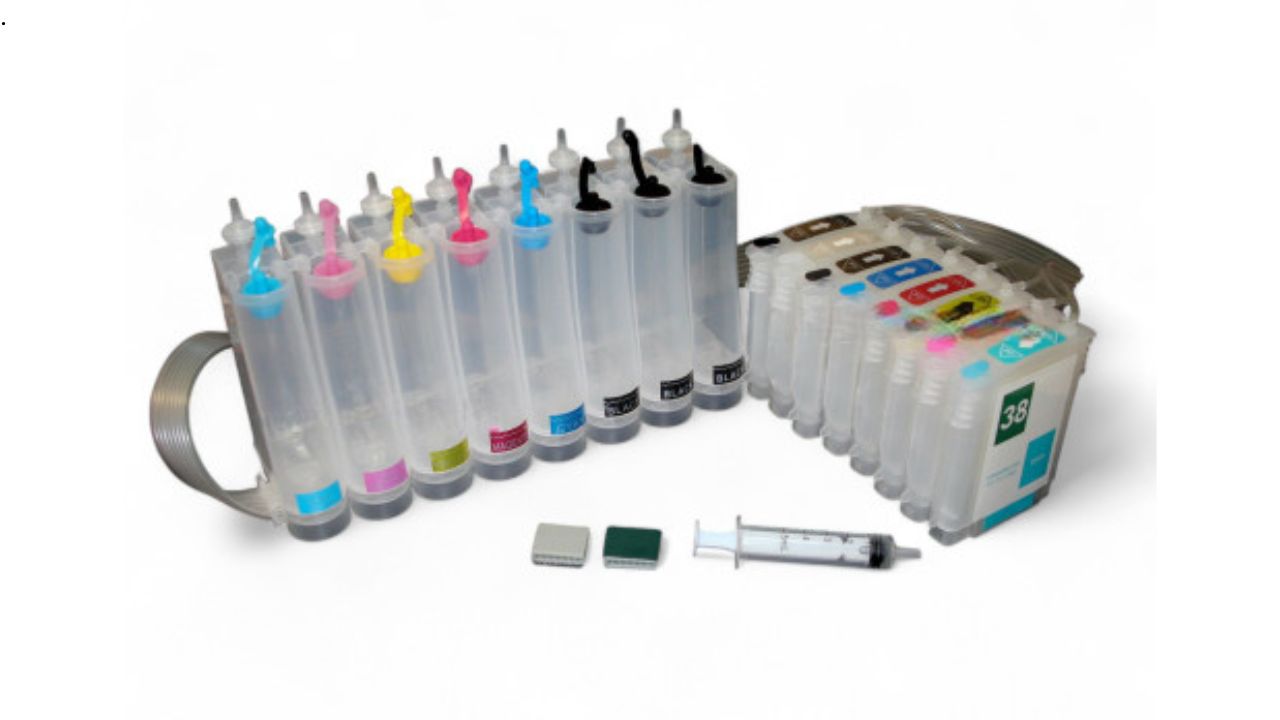
The question of choosing between a Continuous Ink Supply System (CISS) and classic cartridges is relevant for many users — from home users to large offices. To make an informed decision, it is important to consider not only the initial cost of the equipment, but also the real cost of printing, print quality, ease of use, technical risks, and environmental impact.
A Brief Overview of Both Technologies
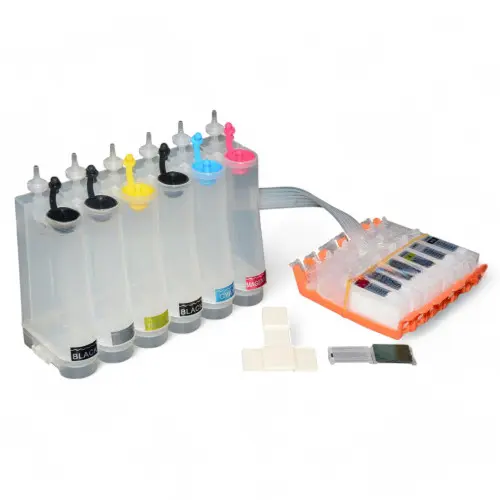
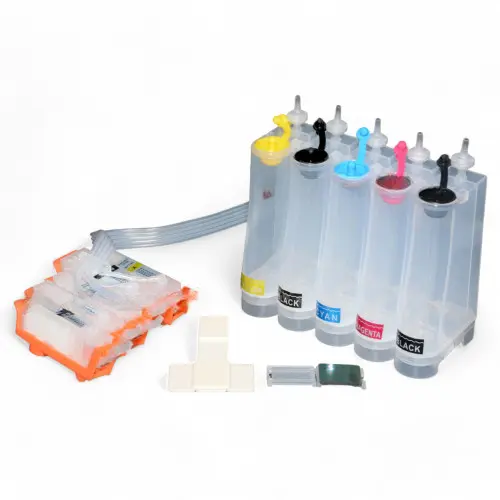
CISS is a system of external transparent ink reservoirs, usually CMYK, connected by tubes to the printer cartridges or printhead. Ink is refilled from larger bottles, with one bottle being enough for thousands of pages.
Cartridges are factory-made or compatible modules that contain a limited amount of ink. Once the ink runs out, they need to be replaced. Original OEM cartridges are usually more expensive, while compatible cartridges are cheaper but may differ in quality.
Printing Costs
To show the real difference, let’s use simple and realistic assumptions with prices in euros:
- Cost of printing one black-and-white page with an original cartridge: €0.15 per page
- Cost of printing one black-and-white page with CISS: €0.0035 per page
approximately: 100 ml of ink ≈ €7 → ≈ 2,000 pages - Cost of printing one color page with original cartridges: €0.45 per page
- Cost of printing one color page with CISS: €0.004 per page
approximately: CMYK set 4×100 ml ≈ €25–30 → thousands of pages
In the examples below, for simplicity, we use the following print mix: 80% black-and-white and 20% color.
Approximate Calculation Examples
Let’s consider three scenarios: a home user, a small office, and a copy center.
For reference, we will use the following monthly print volumes:
- Home: 300 pages/month — 240 black-and-white, 60 color
- Small office: 1,000 pages/month — 800 black-and-white, 200 color
- Copy center: 5,000 pages/month — 4,000 black-and-white, 1,000 color
Calculations
Home
OEM:
240 × €0.15 + 60 × €0.45 = €36 + €27 = €63.00
CISS:
240 × €0.0035 + 60 × €0.004 = €0.84 + €0.24 = €1.08
Monthly savings:
€63.00 − €1.08 = €61.92
Annual savings:
approximately €743.04
Small Office
OEM:
800 × €0.15 + 200 × €0.45 = €120 + €90 = €210.00
CISS:
800 × €0.0035 + 200 × €0.004 = €2.80 + €0.80 = €3.60
Monthly savings:
€210.00 − €3.60 = €206.40
Annual savings:
approximately €2,476.80
Copy Center
OEM:
4,000 × €0.15 + 1,000 × €0.45 = €600 + €450 = €1,050.00
CISS:
4,000 × €0.0035 + 1,000 × €0.004 = €14 + €4 = €18.00
Monthly savings:
€1,050.00 − €18.00 = €1,032.00
Annual savings:
approximately €12,384.00
As you can see, the numbers speak for themselves. The savings are obvious, especially when using a modern system from PRINTOUT: https://printout24.com/
Print Quality and Color Stability
Print quality depends primarily on two factors: the composition of the ink and the condition of the printhead.
When certified, high-quality inks are used, CISS can provide almost the same color reproduction, contrast, and detail as cartridges. Modern CISS inks offer improved light resistance, reduced graininess, and balanced viscosity for continuous ink supply.
Original cartridges are often optimized for specific printer models. Shades and color profiles may be more accurate “out of the box.” This gives OEM cartridges an advantage in professional photography or color printing, where perfect Pantone or ICC profile reproduction is important.
At the same time, a proper choice of high-quality inks combined with printer calibration allows CISS to deliver competitive, or fully acceptable, quality for most tasks.
Technical Features
Cartridges
Advantages:
- easy replacement;
- guaranteed compatibility;
- minimal interference with the printer’s mechanics.
Disadvantages:
- frequent replacements;
- risk of drying out after long periods of inactivity, especially in inkjet printers;
- high operating costs.
CISS
Advantages:
- liquid ink circulates continuously, reducing the risk of nozzle drying;
- large reservoirs mean fewer interruptions;
- transparent tanks make it easy to monitor ink levels;
- modern auto-reset chips simplify operation.
Disadvantages:
- requires careful installation;
- air bubbles or incorrect tube fixation may occur if installed improperly;
- cheap or low-quality ink can increase the risk of contamination or printhead damage.
It is important to note that proper CISS installation and regular preventive maintenance significantly reduce technical risks. Modern CISS kits also often include auto-reset chips and instructions, which minimize the chance of problems.
Impact on Printer Warranty and Manufacturer Restrictions
Printer manufacturers sometimes state that using third-party systems or consumables may void the warranty. In practice, this varies: some service centers strictly follow OEM policies, while others assess the damage individually.
To minimize risks:
- follow the instructions provided by the CISS supplier;
- use certified inks, preferably with laboratory-tested compatibility;
- keep the original cartridges in case warranty repair is needed, as some issues can be demonstrated using original consumables.
Convenience and Speed of Use
Cartridges are simple: remove the old one and insert the new one. For users who print very little, such as a few dozen pages per month, cartridges may be the simpler choice.
CISS is convenient for those who print regularly and in large volumes. There is no need to constantly replace cartridges, the ink supply is much larger, refilling reservoirs is fast, and ink levels can be monitored in real time through transparent tanks or sensors.
When Should You Choose Cartridges?
Cartridges may be the better choice if:
- you print very little, up to around 100 pages per month, and want a “minimum maintenance” solution;
- you need maximum compatibility with OEM color profiles without additional calibration, for example in professional printing;
- you prefer a simple plug-and-play approach and do not want to deal with technical details.
When Should You Choose CISS?
CISS is worth choosing if:
- you regularly print from several hundred pages per month or more;
- savings become noticeable even at medium print volumes;
- minimizing operating costs and reducing environmental impact are important to you;
- you are ready to invest a little time in setup and maintenance, which pays off in the long run;
- you manage a copy center, educational institution, or large office where CISS is often the obvious choice.
Tips for Those Choosing CISS
- Buy CISS from reliable suppliers with certification and positive compatibility test results.
- Use proven inks specifically designed for your printer model.
- Avoid cheap “universal” inks, as they may reduce quality and even damage the printhead.
- Make sure the tubes are laid correctly and avoid sharp bends.
- Perform regular maintenance: printhead cleaning, filter checks, and general system inspection.
- Keep some original cartridges in case you need to contact warranty service.
Final Thoughts
The choice between CISS and cartridges depends on your needs. If the main criterion is the cost of printing at medium and high volumes, CISS provides clear and significant savings. In the examples above, monthly savings are measured in tens, hundreds, and even thousands of euros.
However, if absolute simplicity and maximum warranty compatibility without additional intervention are more important, cartridges may be more suitable for very low print volumes.