
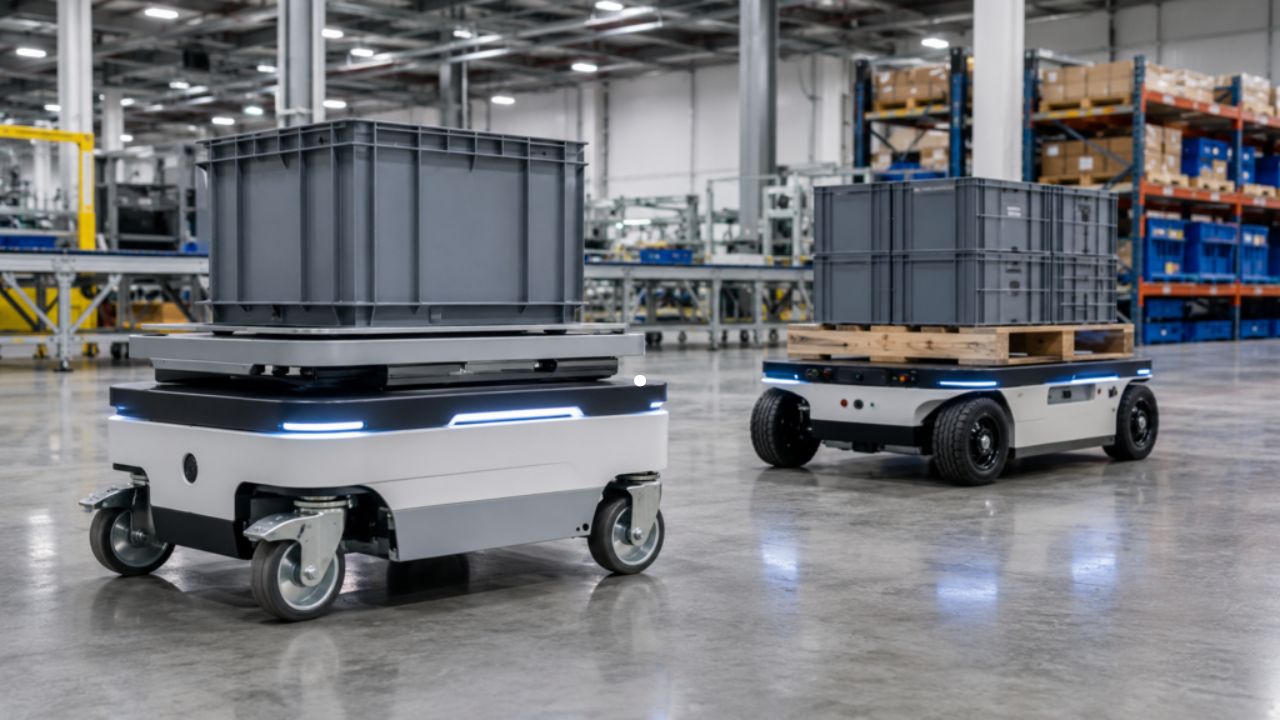
Automated material movement has become a major part of warehouses, factories, distribution centers, hospitals, food facilities, and large retail operations. Automated guided vehicles, autonomous mobile robots, towline carts, robotic picking systems, and powered transfer units all depend on one basic physical function: controlled movement across a floor. Casters play an important role in that movement because they help loads travel, turn, stop, and stay stable as equipment follows planned routes. In systems that require tight turning, swivel casters can help mobile units change direction with less resistance, while steel casters may be selected for certain heavy-duty or high-temperature settings where strength is more important than floor softness or quiet travel.
Although automation is often discussed in terms of software, sensors, robotics, and warehouse management systems, the wheels under the equipment are just as important. A vehicle can have accurate navigation and strong motor control, but poor rolling hardware can still create drag, vibration, tracking errors, uneven wear, floor damage, and safety risks. The success of automated movement depends on how well the mechanical parts match the load, route, floor surface, speed, duty cycle, and work environment.
Why Rolling Components Matter in Automation
Automated material movement is designed to reduce manual handling, support faster movement of goods, and create more predictable workflows. These goals are difficult to reach if the mobile base does not move smoothly. Wheel assemblies carry the weight of the equipment and the material being transported. They also absorb part of the shock created by cracks, expansion joints, dock plates, debris, and uneven surfaces.
In manual carts, a worker can often adjust by pushing harder, slowing down, or correcting direction. Automated systems do not have that same human judgment in the moment. They rely on programmed motion, sensors, and repeatable mechanical behavior. When the rolling parts create too much resistance or fail to track properly, the robot or automated cart may need more power, move less accurately, or stop unexpectedly.
This is especially important in facilities that run long shifts. A cart that moves a few times per day may tolerate lower-grade components. A robotic vehicle that travels hundreds of routes per shift needs rolling hardware that can handle repeated movement without rapid wear.
Load Capacity and Weight Distribution
Load capacity is one of the first factors to consider. The selected wheel assemblies must support the combined weight of the cart, frame, equipment, battery, controls, and carried materials. Buyers should not only look at the average load. They also need to account for peak load, uneven load placement, shock loading, and the number of wheels actually carrying weight at a given time.
In real settings, weight is not always spread evenly. Using load cells helps measure exact weight distribution across the platform. A cart may carry a pallet that sits slightly off center. A robotic platform may turn while the load shifts. A rack may become heavier on one side as items are picked or placed. If the chosen rolling parts are rated too close to the expected load, the system may wear out early or become unstable.
The trade-off is that higher load ratings often mean larger, harder, or more costly components. Larger wheels can roll over obstacles more easily, but they may raise deck height or require more frame clearance. Stronger wheels can handle heavier loads, but they may increase noise or transmit more vibration. The best choice is not always the highest-capacity option. It is the option that matches the load profile, travel path, and operating limits.
Floor Conditions and Surface Compatibility
Automated movement depends heavily on the floor. Smooth concrete allows many wheel materials to perform well, while rough concrete, cracked slabs, tile transitions, outdoor surfaces, and dock areas require more careful selection. A wheel that works well in one area may fail quickly in another.
Hard wheels usually roll with lower resistance on smooth floors. This can reduce battery draw and make powered movement more consistent. However, hard wheels may create more noise, mark sensitive flooring, or struggle with small surface defects. Softer wheels are often quieter and gentler on floors, but they may create more rolling resistance and wear faster under heavy loads.
Floor condition also affects navigation. Autonomous mobile robots use sensors, mapping, and control systems to follow routes. If a wheel bounces, slips, drags, or catches on debris, the vehicle may drift from its planned path. This can affect docking, charging, picking, or handoff points.
Decision-makers should consider not only the current floor, but also the areas the equipment may cross in the future. Routes often change as facilities grow, storage layouts shift, or automation is added to new zones. A wheel choice that only works on one clean aisle may not be suitable for a broader operation.
Turning, Tracking, and Directional Control
Turning behavior is another key part of automated material movement. Some systems need tight turning in narrow aisles. Others need straight-line tracking over longer distances. These two goals can conflict.
A mobile unit that turns easily may not always track as steadily in a straight path. A setup that tracks well may need more room to turn. This is why the layout of the facility matters. Narrow aisles, staging lanes, work cells, dock doors, and conveyor handoff points all influence the correct wheel arrangement.
Automated tugger carts and robotic platforms may use fixed wheel positions, rotating wheel modules, powered drive wheels, or passive support wheels. Each approach affects stability and control. Passive wheel assemblies must follow the motion created by the drive system without creating excess resistance or side loading.
Poor turning behavior can lead to several problems. The vehicle may need more motor torque. The frame may twist under load. Wheels may scrub against the floor during turns. Over time, this can cause uneven wear, higher energy use, and more maintenance.
The best approach is to review the full movement pattern. A system that makes frequent tight turns may need different hardware than one that travels straight between distant warehouse zones. The right selection depends on real travel behavior, not just static load ratings.
Speed, Duty Cycle, and Heat Build-Up
Automated systems often operate for long periods. Some move slowly but almost constantly. Others move faster over shorter routes. Speed and duty cycle affect heat, wear, and bearing performance.
Higher speed can increase heat build-up in the wheel material and bearings. Repeated starts, stops, turns, and loaded travel can also place stress on the mounting structure. A wheel assembly that looks suitable on paper may not last if it is used continuously under demanding conditions.
Duty cycle should be reviewed in practical terms. How many hours per day will the equipment run? How far will it travel per shift? How often will it turn? Will it stop and start under full load? Will it cross thresholds or dock plates? These details help determine whether a product is suitable for light, medium, or heavy use.
There is also a cost trade-off. Components built for heavy duty cycles may cost more at the start, but lower-grade options may need frequent replacement. In automated operations, downtime can be costly because one stopped vehicle may delay several downstream tasks. The lower purchase price may not be the lower total cost.
Material Selection and Environmental Demands
Wheel material affects load handling, noise, floor protection, chemical resistance, temperature resistance, and rolling behavior. Polyurethane, rubber, nylon, phenolic, forged metal, and other materials each serve different needs.
Polyurethane wheels are commonly used where buyers want a balance of load support, floor protection, and smoother rolling. Before buying new wheels, it is worth considering wheel refurbishment as a cost-effective option. Rubber options may help reduce noise and vibration, but they may not be suitable for all heavy loads or chemical exposure. Nylon and phenolic options can be useful in certain industrial settings, but they may be louder and harder on floors. Metal wheels may be needed for extreme heat, heavy loads, or harsh surfaces, but they can be noisy and may damage floors if not used in the right setting.
The environment is just as important as the load. Food processing areas may involve water, cleaning agents, grease, or temperature changes. Medical facilities may require quieter movement and cleanable parts. Manufacturing areas may expose wheels to metal chips, oils, heat, or rough debris. Cold storage can make some materials harder or more brittle.
No single wheel material is right for every setting. Choosing the wrong one can lead to floor damage, early wear, noise complaints, or safety issues. The decision should be based on the operating environment, not just the equipment type.
Energy Use and Battery Performance
Battery-powered automation depends on predictable rolling resistance. When wheels roll freely, motors need less power to move the same load. When resistance increases, the system draws more energy, which can reduce battery life and increase charging frequency.
This becomes important in facilities using autonomous vehicles across multiple shifts. A small increase in rolling resistance may not seem serious on one cart. Across a fleet, it can affect route completion, charging schedules, and system availability.
However, the lowest rolling resistance is not always the right goal. Harder wheels may roll more easily but create more noise, vibration, or floor wear. Softer wheels may require more energy but protect flooring and reduce sound. The choice depends on which outcome matters most for the facility.
Decision-makers should weigh energy use against safety, floor condition, comfort, maintenance, and product life. The best selection usually comes from balancing these factors rather than focusing on one metric.
Safety and Stability Considerations
Automated movement changes the safety picture inside a facility. People may work near moving robots, carts, forklifts, pallet jacks, and conveyors. Rolling hardware affects how safely an automated unit starts, stops, turns, and carries loads.
Stability is especially important when the load is tall, uneven, liquid-filled, fragile, or valuable. If the wheels create sudden jolts or the vehicle tips during a turn, the risk can extend beyond the equipment itself. Products may be damaged, workers may be placed at risk, and nearby systems may be disrupted.
Braking and locking features may also matter, depending on the system design. Some mobile equipment needs to stay fixed during loading, unloading, or machine interaction. Other systems rely on powered brakes within the drive unit. The support wheels must work with the full braking and control design.
Safety decisions should also consider floor slope, travel speed, stopping distance, load center of gravity, and pedestrian zones. A wheel choice that performs well at low speed in an empty test area may behave differently in a busy work cell.
Maintenance and Replacement Planning
Automated operations benefit from planned maintenance. Wheel assemblies should be inspected for flat spots, tread separation, bearing wear, debris buildup, loose fasteners, corrosion, and mounting damage. Waiting until a failure occurs can stop equipment at a bad time.
Facilities should also decide whether they want standardized parts across many carts or specific parts for each application. Standardization can make replacement easier and reduce inventory complexity. Application-specific selection may improve performance in each area, but it can increase the number of replacement parts that must be stocked.
This is a practical trade-off. A warehouse with dozens of similar carts may benefit from common wheel sizes and mounting patterns. A factory with heat zones, wet zones, and heavy tooling carts may need several different options. The right plan depends on how varied the work areas are.
Maintenance records can also guide future purchases. If the same wheel type fails repeatedly in one area, the cause may be overload, surface damage, chemical exposure, poor alignment, or the wrong material. Replacing the same part again may not solve the underlying issue.
Integration With Automation Design
Rolling components should be considered early in the automation design process. Too often, they are treated as basic hardware after the frame, controls, and route plan are already chosen. This can create problems later.
Wheel diameter affects frame height. Mounting style affects structure. Load rating affects frame design. Turning behavior affects aisle width. Rolling resistance affects motor sizing and battery planning. Material selection affects floor wear and noise. These details connect directly to the larger automation system.
Early planning allows engineers, operations teams, and maintenance teams to make better choices together. It also helps prevent redesigns after testing. For example, a vehicle that struggles to dock accurately may not have a sensor problem. It may have a mechanical movement issue caused by wheel scrub, uneven load, or poor tracking.
Final Thoughts
Automated material movement depends on more than robots, sensors, and software. The wheel assemblies beneath the equipment have a direct effect on load handling, energy use, route accuracy, floor protection, safety, noise, and maintenance. They help determine whether automated carts and mobile robots can perform reliably in real work conditions.
The best selection requires a careful review of load weight, floor surface, travel speed, turning needs, duty cycle, environment, and long-term service demands. There are always trade-offs. A harder wheel may roll more easily but create more noise. A softer wheel may protect floors but require more power. A stronger option may last longer but add cost or affect movement. A standard part may simplify replacement but may not suit every area of a facility.
For warehouses, factories, healthcare sites, food plants, and distribution centers, the right rolling hardware can support safer, smoother, and more predictable automated movement. When these components are chosen with the full operation in mind, automation systems are better prepared to handle daily work, changing routes, heavier loads, and longer run times.