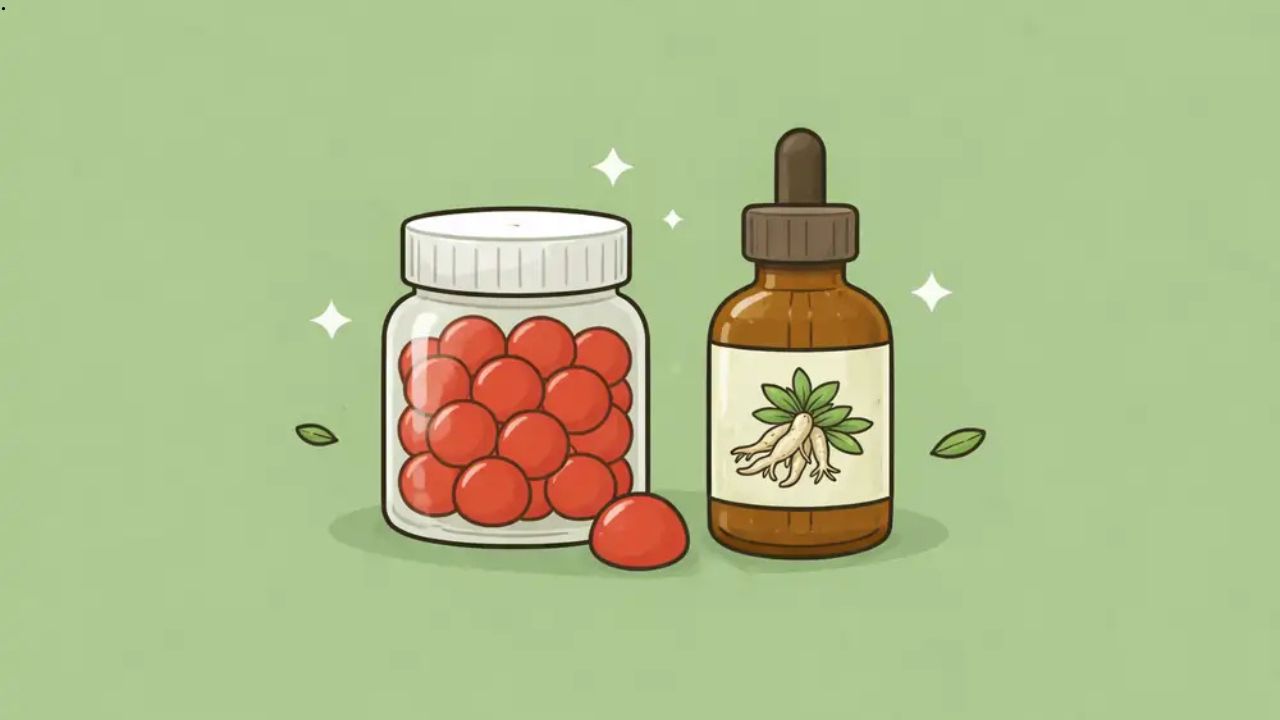
Ashwagandha gummies vs tincture is not just a “form factor” question. The format changes what else you consume (sugars, acids, alcohol), how consistent dosing is, and how likely you are to take it daily. It can also change how your body tolerates it.
This article breaks down the evidence behind ashwagandha (Withania somnifera), then compares gummies and tinctures using practical criteria: ingredients, standardization, dosing accuracy, and safety. This is educational content only and does not diagnose, treat, cure, or prevent disease.
Table of Contents
What matters most when choosing gummies vs tincture?
If you only remember one thing, remember this: the extract quality matters more than the format. A well-standardized extract in a gummy can be more reliable than a low-quality tincture (and vice versa).
After quality, the biggest deciding factors are: tolerability (sweeteners vs alcohol), dosing precision (fixed gummy dose vs variable drops), and adherence (what you’ll actually take consistently).
What does research support ashwagandha for (without hype)?
The strongest human evidence clusters around stress-related outcomes in adults: perceived stress, anxiety symptom scales, and cortisol changes. That does not mean it “works for everyone,” and it does not mean it replaces sleep, therapy, or medical care.
A 2024 meta-analysis of 9 randomized studies (558 participants) found ashwagandha supplementation reduced perceived stress and anxiety scores and lowered serum cortisol versus placebo in the studied populations, with doses commonly ranging from 125–600 mg/day for 30–90 days.
In that same meta-analysis, pooled changes included improvements in Perceived Stress Scale (PSS) and anxiety scales, alongside reductions in serum cortisol—showing a measurable signal, not just subjective reports.
Practical takeaway: most studies use standardized extracts at defined doses for defined durations. So if you’re comparing gummies vs tincture, you want your product to resemble those study conditions as closely as possible.
How are ashwagandha gummies made, and what’s inside besides ashwagandha?
Gummies are typically a standardized ashwagandha extract blended into a gel base. The base often includes sugar or sugar alcohols, acids (for flavor and stability), and natural flavors. Some are vegan (pectin-based), while others use gelatin.
What gummies do well
- Fixed dose per gummy: easier to take the same amount every day.
- High adherence: beginners actually take them, which matters more than “perfect theory.”
- No alcohol: helpful if you avoid alcohol or are sensitive to it.
What gummies can hide
- Added sugars or acids: not ideal for everyone, especially frequent users.
- Lower extract transparency: some labels say “ashwagandha” but do not specify extract type or standardization.
- Heat and stability challenges: gummies can soften, degrade, or lose potency if stored poorly.
How are ashwagandha tinctures made, and what varies most?
Tinctures are liquid extracts. The “solvent system” matters: alcohol-based, glycerin-based (glycerite), or mixed. Tinctures can be made from root only, or from root + leaf, and the extract strength can vary dramatically between brands.
What tinctures do well
- Flexible dosing: you can adjust drops gradually.
- Minimal additives: often fewer sweeteners and less “candy” chemistry.
- Easy to combine: some people add it to water or tea for routine building.
What tinctures can complicate
- Dose uncertainty: “2 droppers” can mean different milligrams of extract across brands.
- Alcohol sensitivity: alcohol tinctures can irritate or be undesirable for some users.
- Standardization gaps: many tinctures do not list withanolide content or equivalent extract strength.
Which form is more “effective”: gummies or tincture?
There is no universal winner because the evidence is mostly about the extract and dose, not whether it came in a gummy or a dropper.
So the effective choice is the one that: (1) uses a credible standardized extract, (2) delivers a dose in the range used in human studies, and (3) you can tolerate and take consistently.
If your gummy uses a clinically studied standardized extract and you take it daily, it can be a more “effective real-world choice” than a tincture you forget or can’t tolerate.
What about absorption and bioavailability?
People often assume liquids absorb “better.” In reality, ashwagandha’s key constituents (withanolides and related compounds) can be delivered effectively in multiple forms, depending on formulation and dose.
What tends to matter more than “liquid vs gummy” is: extract standardization, your digestion and tolerance, and how consistently you take it.
If you want a practical rule: choose the product with clearer labeling (standardization and dose) and fewer ingredients that upset your stomach.
How do gummies and tinctures compare for dosing accuracy?
Dosing accuracy is where gummies usually win.
| Factor | Gummies | Tincture | Why it matters |
|---|---|---|---|
| Dose consistency | High (fixed mg per gummy) | Variable (drops/droppers vary) | Consistency helps you evaluate effects and side effects |
| Label clarity | Mixed | Mixed | Both can be vague; you need standardization details |
| Ability to “micro-adjust” | Low | High | Useful if you’re sensitive and want gradual changes |
| Adherence | Often higher | Depends on taste/routine | Taking it beats “perfect” dosing you don’t follow |
Which is safer for daily use?
Safety depends on your personal context. Both forms can cause side effects, and both can interact with medications. Supplements can affect people differently, and understanding how different compounds interact with the body is important. For example, learning about THC vs CBD can also help readers see how plant-based compounds may produce very different effects.
Commonly reported side effects
- Stomach upset, nausea, loose stool
- Drowsiness or “too calm” feeling
- Headache (less common)
Important cautions to take seriously
- Pregnancy: avoid unless a qualified clinician specifically advises otherwise.
- Thyroid conditions or thyroid medication: be cautious and discuss with a clinician.
- Sedatives, alcohol, or sleep meds: ashwagandha may add to drowsiness for some people.
- Liver concerns: rare cases of liver injury associated with ashwagandha have been reported in medical literature and safety reviews.
Stat block: A NIH LiverTox review (updated Dec 3, 2024) notes that multiple cases of clinically apparent liver injury attributed to ashwagandha have been reported in the literature, with typical onset after weeks of use and most cases resolving after stopping, though severe outcomes have been described.
Format-specific note: if you avoid alcohol, choose gummies or a glycerin-based tincture. If you avoid sugar alcohols or acids that trigger reflux, a tincture may feel better.
Which one is better for beginners who want a “simple routine”?
Beginners usually succeed with the simplest routine. Gummies tend to be the easiest “set-and-forget” option because the dose is fixed and the experience is consistent.
Tinctures are better for people who like dialing in a routine and are comfortable measuring drops daily. If you already do other tinctures, it can fit smoothly.
What should you look for on the label?
This is where most buying mistakes happen. Marketing claims are loud; the useful details are small.
Quality signals for both gummies and tinctures
- Botanical name: Withania somnifera.
- Plant part: root-only vs root + leaf.
- Standardization: withanolides % plus the extract type, not just “proprietary blend.”
- Actual dose: mg of extract per serving (not just “equivalent to raw herb”).
- Third-party testing: identity + contaminants (heavy metals, microbes).
Extra checks for gummies
- Total sugars per serving
- Sugar alcohols (if they upset your stomach)
- Acids (citric acid can bother sensitive stomachs)
Extra checks for tinctures
- Solvent (alcohol vs glycerin vs mixed)
- Extract ratio or strength information
- Dropper volume (mL per serving)
Checklist: choose the right form in 60 seconds
- Pick your non-negotiable: no alcohol → gummies or glycerite; no sugar alcohols → tincture or capsule.
- Confirm the extract: Withania somnifera + plant part + standardization details.
- Match research-like dosing: look for a clear mg dose in a realistic daily range used in trials.
- Reduce variables: avoid “kitchen sink” blends if you’re testing ashwagandha for the first time.
- Track for 2–4 weeks: sleep quality, daytime calm, stomach comfort.
- Stop if you react: significant drowsiness, rash, persistent GI upset, or unusual symptoms—then consult a clinician.
Ashwagandha Gummies vs Tincture | FAQ
Are ashwagandha gummies as effective as tinctures?
They can be, if the gummy uses a credible standardized extract and delivers a similar daily dose. The format alone does not decide effectiveness.
Which absorbs better: gummies or tincture?
Absorption depends more on extract quality, dose, and tolerance. Consistent use often matters more than the delivery form.
Which is better for people who avoid alcohol?
Gummies or glycerin-based tinctures. Alcohol tinctures are not ideal if you avoid alcohol.
Do gummies have downsides?
Yes. They may add sugar, acids, or sugar alcohols. These can affect teeth, digestion, or reflux in sensitive people.
Can ashwagandha cause side effects?
Yes. Stomach upset and drowsiness are reported. Rare liver injury cases have been described in the medical literature.
How long should you try it before deciding?
Many studies run 30–90 days. A practical personal trial is 2–4 weeks at a steady dose, unless side effects occur sooner.
Glossary
- Withania somnifera: The botanical name for ashwagandha.
- Withanolides: Marker compounds often used to standardize ashwagandha extracts.
- Standardized extract: A product adjusted to contain a consistent level of marker compounds.
- Tincture: A liquid extract made with alcohol, glycerin, or a mix.
- Glycerite: A glycerin-based herbal extract (typically alcohol-free).
- Placebo-controlled trial: A study design that compares a supplement to an inactive control.
- Perceived Stress Scale (PSS): A commonly used questionnaire to measure perceived stress.
- Cortisol: A hormone often measured in stress-related studies.
Conclusion
Choose gummies when you want consistency and ease. Choose tincture when you want flexible dosing and fewer candy-style additives—then prioritize extract quality either way.
Sources used
- NIH Office of Dietary Supplements (ODS). “Ashwagandha: Is it helpful for stress, anxiety, or sleep?” Health Professional Fact Sheet. Updated May 2, 2025.
- NIH Office of Dietary Supplements (ODS). Ashwagandha Consumer Fact Sheet. Updated Dec 4, 2023.
- Arumugam V. et al. Meta-analysis on ashwagandha effects on stress, anxiety, and cortisol (9 randomized studies; 558 participants; doses commonly 125–600 mg/day for 30–90 days). 2024. (Published in a peer-reviewed journal hosted by ScienceDirect.)
- NIH NCBI Bookshelf, LiverTox. “Ashwagandha.” Updated Dec 3, 2024. (Review summary of reported ashwagandha-associated liver injury cases.)
- NCCIH (National Center for Complementary and Integrative Health). “Ashwagandha: Usefulness and Safety.” (General safety overview and cautions.)
- European Medicines Agency (EMA). “Withaniae somniferae radix” page noting no adopted EU herbal monograph by HMPC (public regulatory context).
- Philips C.A. et al. “Ashwagandha-induced liver injury—A case series…” Hepatology Communications. 2023. (Clinical case series context for herb-induced liver injury reports.)