

When sources in an AI-generated company brief disagree, do not simply pick the figure that looks most plausible. First confirm that every source describes the same legal entity. Then check that the figures cover the same period and measure the same thing. Only then weigh the sources for that specific claim, and write down which one you used and why. If a conflict cannot be resolved, leave it in the brief as an open question.
AI tools can produce a tidy company brief in minutes: founding date, revenue, headcount and recent deals, all in confident sentences. One weak point is easy to miss. Two real sources can disagree, and a summary may present one figure without mentioning that another exists. (A tool can also state a figure with no support at all, which calls for a separate check: open the source and confirm it says what the brief claims.)
This guide looks at three kinds of conflict worth checking (who the company is, when something happened and how big a number is) and works through them with one invented example.
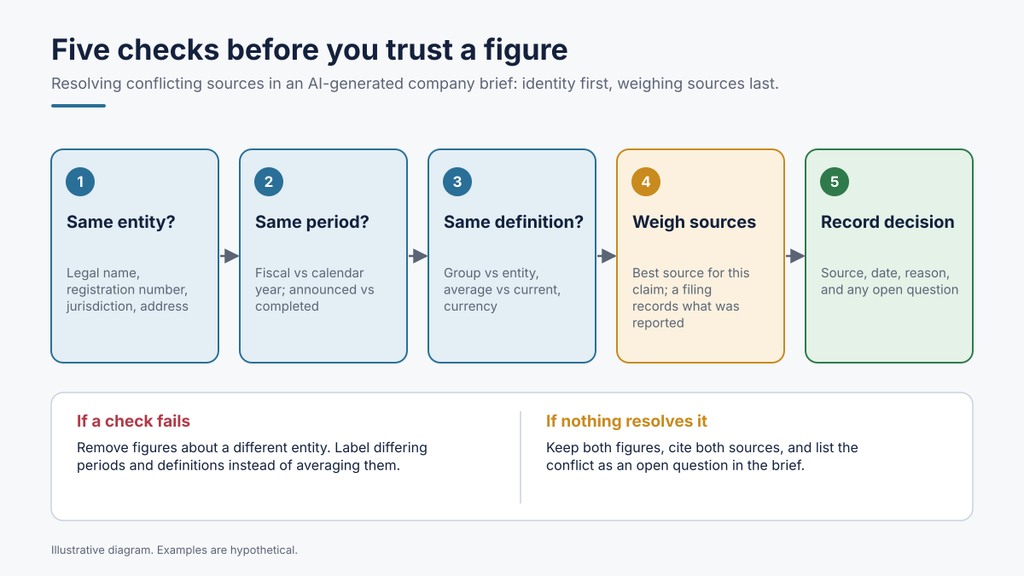
Resolve a source conflict in order: confirm the entity, align the period, compare definitions, weigh the sources for the specific claim, then record the decision.
Why Can AI Research Briefs Contain Conflicting Facts?
AI research tools can pull from websites, registries, news, aggregators, press releases and profiles. Those sources were written at different times, for different readers, and sometimes about different companies with similar names. A fluent summary can smooth over differences a careful reader would want to see.
A useful way to sort conflicts is into three types:
- Identity conflicts: the sources may describe different legal entities, such as a parent and a subsidiary, two firms with similar names, or a company before and after a rename.
- Timing conflicts: the sources may describe different dates or periods, such as a fiscal year versus a calendar year, or an announcement versus a completed deal.
- Measurement conflicts: the sources may use different definitions, such as group versus single-entity revenue, or average versus current headcount.
A Worked Example: One Brief, Several Conflicts
Suppose an AI tool produces a brief on a mid-sized industrial supplier we will call Harlow Components Ltd. The company, the sources and every figure below are invented to show the method. When you open the sources behind the brief, you find this:
| Claim | What the brief says | What the sources show |
|---|---|---|
| Revenue | $48 million | Filed UK accounts show £31.0 million for the year ending 31 March; a trade news story says $48 million |
| Founded | 2009 | The company website says “trading since 2009”; the registry shows incorporation in 2011 |
| Headcount | 410 | A profile site says 410; the careers page says “400+”; filed accounts give an average of 352 for the year |
| Acquisition | 2023 | A press release announced a deal in November 2023; a later filing records completion in February 2024 |
Every line contains a conflict, and each needs a different fix.
Step 1: Confirm That Every Source Describes the Same Entity
Start with identity: there is little point debating figures that belong to two companies. For each source, check the legal name, registration number, jurisdiction and registered address. Trading names, parent groups and overseas affiliates are possible traps.
Official registries help anchor this step. In the UK, the Companies House register makes its public company data available free of charge. For entities involved in financial transactions, GLEIF describes the Legal Entity Identifier as a unique 20-character alphanumeric code linked to reference data that can include ownership structure.
In our example, the trade news story is about Harlow Components Inc, a separate company in the United States. The brief had merged two entities, so the $48 million figure leaves the brief entirely.
Step 2: Line Up Dates and Periods
A single event can carry several legitimate dates: announced, signed, completed, effective, filed and published. The November 2023 announcement and the February 2024 completion can both be true. The brief just needs to say which is which.
Financial periods need the same care. A company’s fiscal year may not match the calendar year, and the SEC’s investor guide notes that the management discussion in a 10-K covers the past fiscal year. “Year ending 31 March” is not the same as “2025”, so attach the period end date to every financial figure.
Step 3: Check That the Figures Measure the Same Thing
The headcount conflict shows why definitions matter. 352 is an average across a financial year from filed accounts, “400+” is a rounded current claim from the company, and 410 comes from a profile site with no stated date or method. These are three different measurements, not three guesses at one number.
Watch for revenue versus bookings, one entity versus the whole group, employees versus contractors, and currency conversions at an unstated rate. If you cannot tell how a figure was defined, treat it as weaker evidence.
Step 4: Weigh the Sources for This Specific Claim
Only now should you decide which source to rely on. A rough guide:
| Source type | Often useful for | Keep in mind |
|---|---|---|
| Official filings and registries | Legal identity, reported financials, dates of record | A primary record of what was reported, not independent assurance |
| The company’s own statements | What the company says about itself now | Marketing language and rounding |
| Independent reporting | Events and context | May repeat the company’s own figures |
| Aggregators and profile sites | Leads to follow up | May have no stated date or method |
An official filing is a primary record: it shows what the company formally reported under the rules for that filing. That makes it strong evidence of what was reported, but it is not automatic independent assurance that every statement in it is correct. Filings can also be older than a press release. Prefer the most authoritative source for a defined period, the most recent credible source for the current state, and say which you did.
Step 5: Record the Decision, Not Just the Answer
The corrected brief should show its reasoning in a line or two:
- Revenue: £31.0 million, year ending 31 March (filed accounts). A $48 million figure in an earlier draft referred to Harlow Components Inc, a different company, and was removed.
- Headcount: average of 352 for the financial year (filed accounts). The careers page states “400+” (with the date accessed).
- Founded: trading since 2009, according to the company; incorporated in 2011 (registry). Both can be true.
- Open question: whether the acquired business is included in the reported revenue.
Where Do Research Tools Fit?
Tools can make this method less tedious by keeping evidence attached to every claim. Grep by Parcha Labs builds custom research agents that link each finding to its source and can rerun checks on a schedule.
Whatever produced the brief, a reviewer can put three questions to any figure. Can I open the source? Does the source describe this entity and this period? Does the brief say why this figure was chosen over the alternatives? If any answer is no, treat the figure as a lead rather than a finding, and note what would settle it.
Conclusion
Conflicting sources are a normal part of company research. Work through them in order: same entity, same period, same definition, then weigh the sources for the claim at hand. Record what you decided and keep unresolved conflicts visible. A brief that admits one open question is more useful than one that hides three.
Frequently Asked Questions
Why might AI research mix up companies with similar names?
A tool that matches on names rather than registration numbers can pull a parent, a subsidiary or an unrelated firm into one summary. Checking registry details for each source reduces that risk.
Which should I rely on when a company’s website and its filings disagree?
For defined periods, filings can carry more weight because they are formal records prepared under set rules, though they are not independent verification. For current claims, the website may be newer. Record both and state which you relied on.
Should I delete a conflicting figure or keep it?
Remove figures that belong to a different entity. Keep other conflicts with a short note, because the disagreement itself can be useful information.
Can AI tools resolve source conflicts on their own?
They can help find and flag conflicts quickly, but a person should confirm identity and definitions before a figure is used in a decision.