

To track brand mentions in AI-generated answers, run a fixed sample of buyer-style prompts on the assistants your audience uses, repeat each prompt several times, and log four separate signals: whether your brand is named, whether your site is cited with a link, whether you are recommended, and whether anyone clicks through. Add first-party data from Bing Webmaster Tools, Google Search Console and your analytics, and treat the results as a sample rather than a full count.
A brand mention inside an AI answer is easy to screenshot and hard to measure. One person asks ChatGPT for project tools and sees your name. A colleague asks the same thing an hour later and sees three competitors instead. Both screenshots are real, and neither tells you much on its own.
Tracking starts to work when you stop collecting anecdotes and start collecting comparable records. That means deciding what counts as a mention, sampling answers in a repeatable way, and keeping the different kinds of visibility apart so that a rise in one is not mistaken for a rise in another.
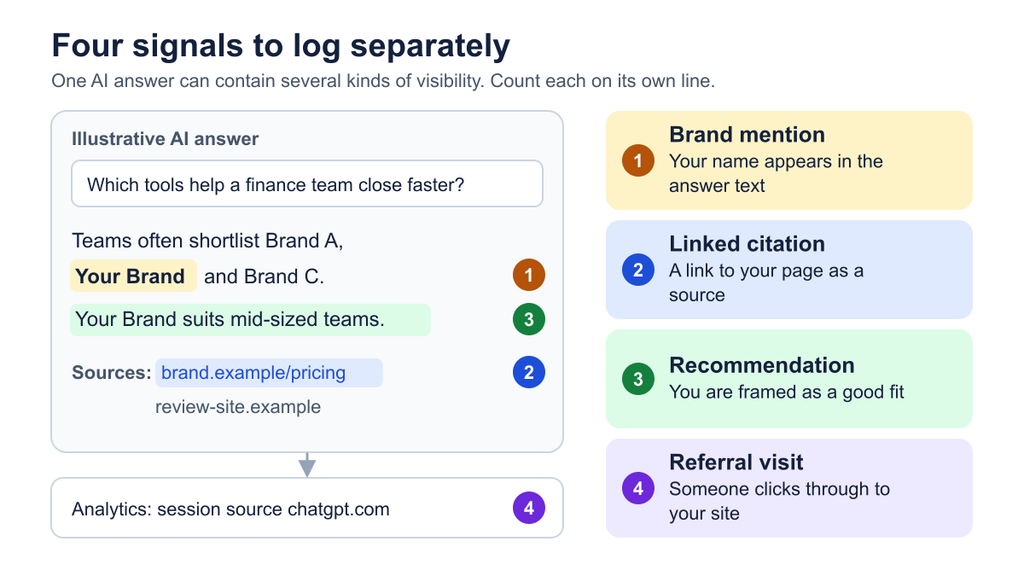
Four separate signals can sit inside one AI answer. Log each one on its own line.
“We Got Mentioned” Can Mean Four Different Things
When a team says an AI tool mentioned them, it could be describing any of these events:
- Brand mention: the answer names your company or product in its text, with or without a link.
- Linked citation: the answer points to a page on your domain as a source. ChatGPT, for example, shows inline citations and a Sources list on search-based responses, according to OpenAI’s help article on ChatGPT search.
- Recommendation: the answer presents you as a good option for the person’s need, rather than naming you in passing or as a warning.
- Referral visit: someone clicks from the answer to your site and shows up in your analytics.
These signals overlap, but each can happen without the others. An assistant can cite your pricing page while recommending a rival. It can name you in a list without linking anywhere. A referral can arrive from an answer you never saw in your own sample. Rolling them into one number hides all of that.
| Signal | What you see | Where to find it | What it does not prove |
|---|---|---|---|
| Brand mention | Your name in the answer text | Your own prompt sample | That the description is accurate or favorable |
| Linked citation | A link to your page as a source | Your sample; Bing Webmaster Tools for Microsoft surfaces | That anyone clicked |
| Recommendation | You framed as a good fit | Your sample, reviewed by a person | That buyers act on it |
| Referral visit | A session from an AI tool | Your web analytics | Which prompt produced it |
Build a Prompt Sample Before You Count Anything
No outside tool can see every conversation people have with an assistant, so every tracking method rests on a sample. The quality of that sample decides the quality of your numbers.
Write prompts the way buyers actually ask
Start with questions your sales team hears. Mix category questions (“what tools help finance teams close the month faster”), comparison questions (“Vendor A versus Vendor B for a 50-person company”) and problem questions that do not name any product. Include a few prompts that name your brand directly, because they show how assistants describe you when asked, which is a different question from whether you come up unprompted. Keep the list small enough to review by hand, often a few dozen prompts per product line.
Repeat runs and record the conditions
Generated answers change between runs, so one run tells you what happened once. Run each prompt several times per engine on a set schedule. Record the date, the engine, the mode (for example, whether web search was used) and the account or location setup, since those can change what appears. When you report, describe results as a share of runs, such as “named in 6 of 10 runs,” rather than as a fixed position.
What to Record for Every Answer
A spreadsheet is enough to start. What matters is consistency. For each answer, capture:
- The prompt text, engine, mode, date and run number
- Whether your brand was named, and in what context: recommended, listed, compared or criticized
- Which competitors were named
- Every cited URL, and whether any belong to your domain
- Whether the description of your product was accurate, with notes on any errors
- A saved copy of the full answer, so someone else can check the classification later
The saved copy matters more than it seems. Calls such as “recommended” versus “listed” involve judgment. Keeping the raw text lets a second person review borderline cases, and it keeps your trend line honest when the person doing the tracking changes.
Use the First-Party Data That Exists
Your own sample shows what answers say. Platform reports show activity you could never sample yourself, although each one covers only its own surfaces.
Microsoft’s AI Performance report in Bing Webmaster Tools shows how often your pages are cited across Microsoft Copilot, AI-generated summaries in Bing and select partner integrations, including page-level citation counts and grounding queries. Microsoft notes that the grounding query data is a sample and that the figures do not indicate ranking or authority.
Google announced Search generative AI performance reports in June 2026, initially rolling them out to a subset of sites. Check whether the dedicated impressions view is available in your property. In web analytics, inspect observed session sources, referrers and campaign parameters to identify AI referrals. Test real link paths rather than assuming every visit carries the same tracking parameter.
None of these sources tells you what an answer actually said about you. That is why the prompt sample and the platform data work best side by side.
Stay Inside the Rules
Automating checks can save time, but read each provider’s terms first. OpenAI’s consumer terms, for example, restrict automated or programmatic extraction of output. Use only collection methods allowed by the applicable service terms and API documentation. Answers produced through an API may not match what people see in the consumer app, since settings such as search, model choice and personalization can differ, so note which one your sample uses rather than mixing them.
Keep privacy in mind as well. Use neutral test accounts, keep personal and customer data out of prompts, and store saved answers where access is controlled. If you also crawl your own site to check what assistants can reach, respect robots.txt and the access rules of any third-party sites involved.
Turning the Log Into Decisions
A mention log is only useful if it leads to work. Patterns worth acting on include prompts where competitors appear and you never do, answers that repeat an outdated feature or price, and cited third-party pages that describe your category without naming you. Each points to a different fix: clearer pages on your own site, corrected details on profiles and directories, or earned coverage on the sources assistants already use.
Some teams run all of this in-house. Others hand the execution to a done-for-you partner such as GoBlinkly, which runs answer engine optimization for B2B brands together with the SEO and content work behind it, and tracks visibility as part of the service. Whichever route you choose, insist that mentions, citations, referrals and leads are reported separately.
Conclusion
Tracking brand mentions in AI answers is a sampling exercise. Define the signals, write realistic prompts, repeat them, save the raw answers, and combine your sample with first-party reports from Microsoft, Google and your analytics. Expect variation, report shares rather than positions, and judge progress over months rather than days.
Frequently Asked Questions
Can I see every time an AI tool mentions my brand?
No. Conversations are private to the people having them, so any method relies on a sample of prompts plus whatever first-party reporting a platform offers. Treat the numbers as an estimate of visibility, not a complete count.
What is the difference between a mention and a citation?
A mention is your brand named in the answer text. A citation is a link to a page used as a source. You can be mentioned without being cited, and cited without being recommended.
How often should I run my prompt sample?
Monthly is a practical starting point, with extra checks after major site changes or launches. Use the same prompts and conditions each time so results stay comparable.
Does a mention mean the AI tool recommends us?
Not necessarily. Read the context. Being listed, compared unfavorably or described inaccurately all count as mentions, which is why a person should review how each answer frames the brand.