Table of Contents
Why Accurate Data Matters for the Hydrogen Economy
Hydrogen is rapidly becoming a cornerstone of the global clean-energy transition. Governments, technology companies, and industrial operators are investing heavily in hydrogen production and infrastructure to reduce carbon emissions and support sustainable energy systems. However, scaling hydrogen safely and efficiently requires more than renewable electricity and electrolyzers. It demands precise, real-time insight into process conditions.
Artificial intelligence is already being deployed across hydrogen facilities to optimize operations, predict equipment behavior, and improve efficiency. Yet the performance of these AI systems depends fundamentally on the quality and reliability of the data they receive. Without accurate measurements, even advanced algorithms struggle to make correct operational decisions.
Recent developments in real-time measurement technologies are helping solve this challenge, enabling AI-driven hydrogen systems to operate with greater reliability and safety.
The Role of Real-Time Measurement in AI-Driven Hydrogen Systems
In many hydrogen production facilities, artificial intelligence is used to analyze operational data and optimize process performance. AI models can help regulate electrolysis conditions, manage purification units, and monitor safety-critical parameters such as gas composition, pressure, and temperature.
However, traditional monitoring approaches often rely on delayed laboratory analysis or indirect measurements. These methods can introduce uncertainties and prevent AI systems from responding quickly to changing process conditions.
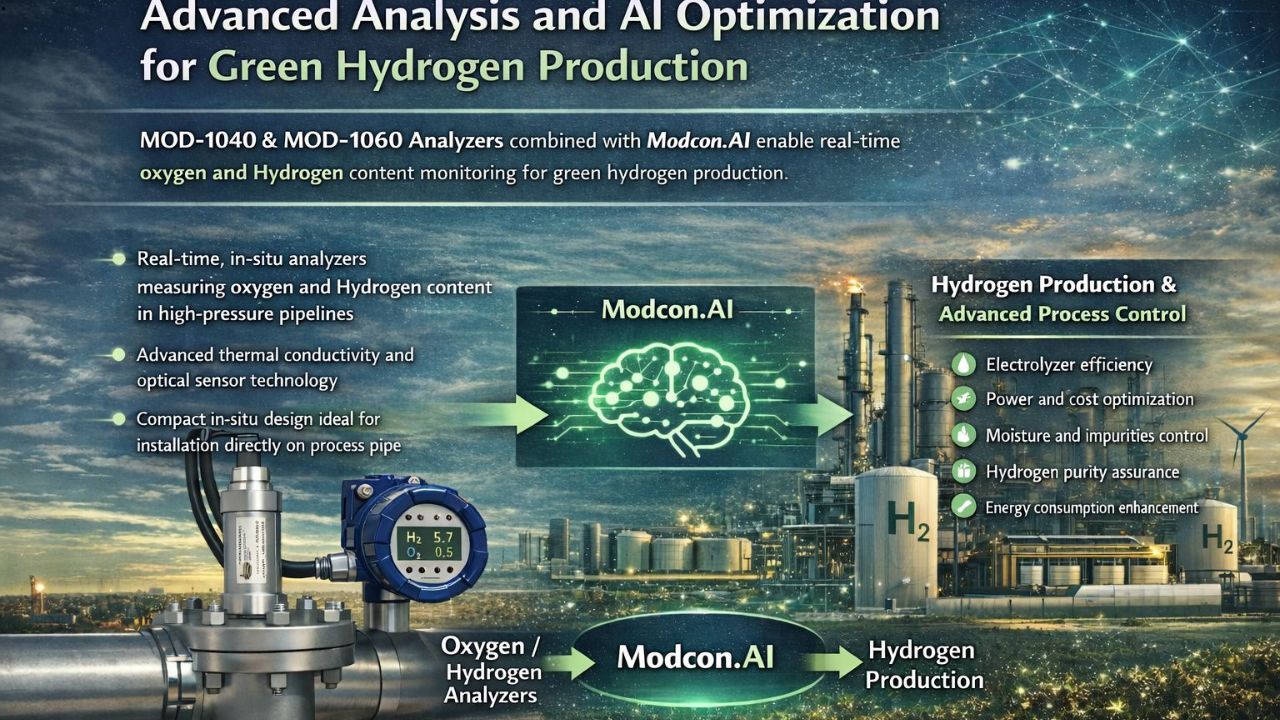
Industry observers increasingly recognize that AI-driven infrastructure requires direct, real-time measurements to function effectively. Instead of relying on estimated values, modern hydrogen facilities are beginning to integrate sensors and analyzers directly into critical process streams. These devices provide continuous data that feeds directly into control systems and optimization platforms.
The result is a shift toward operational models where AI algorithms respond to verified physical conditions rather than approximations or historical trends.
AI and Sensors: A Powerful Combination
The convergence of artificial intelligence and advanced process gas analyzers is transforming hydrogen monitoring.
Modern hydrogen sensing systems can continuously detect gas composition and environmental changes. When combined with AI analytics, these systems can identify anomalies, predict failures, and improve safety monitoring. Researchers note that integrating hydrogen sensors with data analytics and IoT platforms enables real-time monitoring across large industrial facilities and supports intelligent safety management.
This integration provides several important advantages:
1. Faster decision-making
AI systems can react instantly to real-time sensor data, allowing operators to stabilize processes or prevent unsafe conditions before they escalate.
2. Improved operational efficiency
Continuous monitoring allows optimization algorithms to fine-tune process conditions, improving hydrogen production yields and energy efficiency.
3. Enhanced safety
Hydrogen is highly flammable, and early detection of abnormal gas concentrations is essential. Real-time monitoring systems help detect leaks or deviations rapidly.
Hydrogen Production Requires Intelligent Monitoring
Hydrogen production processes—such as water electrolysis, steam methane reforming, or biomass gasification—are complex systems influenced by multiple variables including pressure, temperature, and gas composition.
Artificial intelligence is increasingly used to analyze these variables and improve process control. AI techniques such as machine learning, predictive modeling, and neural networks can optimize electrolysis efficiency, forecast system behavior, and enhance predictive maintenance programs.
However, these AI tools require high-quality data streams. Inaccurate or delayed measurements can reduce algorithm reliability and increase operational risk.
Real-time measurement therefore becomes a foundational component of AI-enabled hydrogen infrastructure.
Digitalization and the Hydrogen Energy Transition
The transition to hydrogen energy is not only a shift in fuel sources but also a transformation in how industrial facilities operate. Digitalization plays a central role in this change.
Advanced hydrogen facilities increasingly incorporate:
- AI-based optimization platforms
- digital twins for process simulation
- predictive maintenance algorithms
- sensor networks for continuous monitoring
Together, these technologies create intelligent energy systems capable of adapting to changing operating conditions and improving efficiency over time.
Artificial intelligence can process vast volumes of sensor data, identifying patterns that human operators might miss. This enables early fault detection, improved reliability, and optimized system performance.
When combined with direct measurement technologies, AI becomes a powerful tool for managing complex hydrogen infrastructure.
Industry Recognition for Real-Time Hydrogen Measurement
As hydrogen technology evolves, innovations in real-time measurement are gaining increasing recognition within the industry.
Experts acknowledge that reliable data is essential for enabling safe and effective AI-driven process control. Direct measurement technologies integrated into hydrogen production and purification systems allow operators to monitor conditions continuously and respond immediately to process changes.
This growing recognition highlights a broader trend: the hydrogen industry is moving toward data-driven operations where real-time measurements form the backbone of intelligent control systems.
Challenges in Hydrogen AI Systems
Despite the progress, several challenges remain in integrating AI and real-time monitoring within hydrogen facilities.
Data availability
AI models require large datasets for training and validation. In emerging hydrogen infrastructure, such datasets are still limited.
Regulatory frameworks
Regulatory standards for AI-based safety monitoring are still evolving, and accountability for AI decisions remains an ongoing discussion within the industry.
Sensor reliability
Hydrogen environments can involve extreme pressures, temperatures, and corrosive conditions. Sensors must operate reliably in these environments while maintaining measurement accuracy.
Addressing these challenges will require collaboration between sensor developers, AI engineers, and regulatory authorities.
The Future of Intelligent Hydrogen Infrastructure
Looking ahead, the hydrogen sector is expected to rely increasingly on integrated digital systems combining sensors, AI analytics, and automated control platforms.
Future hydrogen facilities may operate with:
- distributed sensor networks monitoring entire plants
- AI-driven control loops adjusting process parameters automatically
- predictive safety systems detecting potential leaks or failures before they occur
- digital twins simulating plant behavior in real time
Such systems could dramatically improve the reliability and economic viability of hydrogen production.
As global energy systems move toward decarbonization, intelligent monitoring technologies will play a critical role in ensuring that hydrogen infrastructure operates safely and efficiently.
Conclusion
The rapid growth of hydrogen energy is driving the adoption of advanced monitoring technologies and artificial intelligence. While AI offers powerful tools for optimizing hydrogen production and infrastructure management, its effectiveness depends on accurate and continuous measurement data.
Real-time sensing technologies provide the reliable information that AI systems need to operate effectively. By integrating advanced analyzers, sensor networks, and digital optimization platforms, hydrogen facilities can achieve safer operations, improved efficiency, and more responsive process control.
As the hydrogen economy continues to expand, the combination of real-time measurement and AI-driven analytics will likely become a defining feature of next-generation energy infrastructure. Several companies are developing advanced analytical systems designed for real-time hydrogen monitoring. For example, engineering firms such as Modcon Systems, known for its work in industrial process analyzers and AI-enabled optimization technologies, have introduced monitoring solutions designed for high-pressure hydrogen environments.