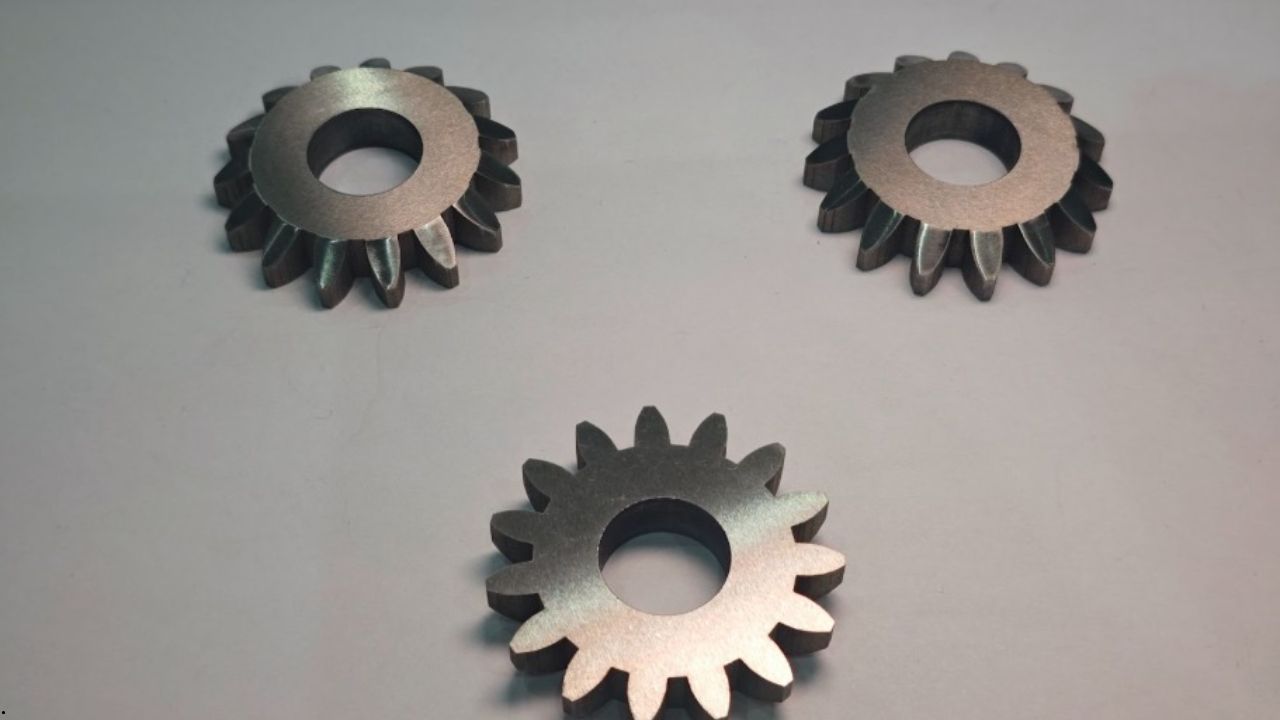
Wisconsin automotive transmission supplier manufacturing 12,000 annual helical gears faced challenge: 11.5% rejection rate (dimensional non-conformance, surface finish failures), $127,000 annual scrap cost, 14-day lead times missing production schedules. Root cause analysis revealed: over-specified tolerances (AGMA 10 when AGMA 8 adequate), inefficient hobbing parameters (conservative speeds causing excessive cycle time), lack of in-process inspection (defects detected post-completion). Solution: Tolerance rationalization (AGMA 8 for non-critical features), optimized cutting parameters (18% cycle time reduction), automated CMM inspection every 50th part. Results: Rejection rate 2.1%, $106,000 annual savings, 9-day lead times, zero customer complaints.
This demonstrates CNC gear cutting cost reduction without quality compromise requires systematic approach: design optimization, method selection matching application, tooling strategy, process control—not arbitrary cost-cutting destroying precision. Understanding premium CNC machining solutions for gears enables competitive pricing while maintaining aerospace gear machining quality standards.
Table of Contents
Gear Cutting Method Cost Comparison
| Method | Setup Cost | Cycle Time (50mm gear) | Tool Cost/Life | Accuracy (AGMA) | Volume Economics | Best Applications |
|---|---|---|---|---|---|---|
| Hobbing | $180-$450 | 3-8 min | $85-$280/500-2000 parts | AGMA 8-11 | >100 units economical | External spur/helical, high volume |
| Shaping | $220-$550 | 5-12 min | $120-$350/300-800 parts | AGMA 8-10 | >50 units economical | Internal gears, shoulders limiting hobbing access |
| 5-Axis Milling | $90-$250 | 8-25 min | $45-$180/50-200 parts | AGMA 6-9 | <100 units economical | Prototypes, complex geometries, bevel gears |
| Grinding | $350-$850 | 12-40 min | $180-$650/200-600 parts | AGMA 11-14 | Finishing only | Hardened gears, aerospace precision, noise-critical |
| Broaching | $2K-$8K (tooling) | 1-4 min | $800-$3K/5K-15K parts | AGMA 8-10 | >5,000 units | Internal splines, high volume, specific profiles |
Strategic selection: often starts with a clear understanding of CNC machining basics, especially for prototyping and low-volume production (<50 units) where 5-axis milling is most effective. Medium volume (50-5,000) spur/helical → hobbing. Internal gears → shaping. Ultra-precision → grind after hobbing/shaping. Extreme volume (>10,000) dedicated profiles → broaching (tooling investment justified).
Design for Manufacturability: Cost Reduction at Source
Tolerance rationalization (biggest cost driver):
- AGMA 14 (aerospace turbine): ±0.003mm, requires grinding, $180-$450/gear
- AGMA 11 (automotive transmission): ±0.008mm, hobbing sufficient, $45-$85/gear
- AGMA 8 (robotics reduction): ±0.015mm, standard hobbing, $25-$55/gear
- Impact: Specifying AGMA 11 when AGMA 8 adequate increases cost 60-90% unnecessarily
Module/pitch standardization:
- Standard modules (1.0, 1.5, 2.0, 2.5, 3.0 mm): Stock hobs available, $85-$180 tool cost
- Custom module (1.75mm): Special hob required, $850-$1,500 tool cost, 3-4 week lead time
- Recommendation: Design around standard modules unless performance mandates custom
Root fillet optimization:
- Sharp fillet (0.2mm radius): Requires special hob grind, increases tool cost 40-60%
- Standard fillet (0.38× module): Standard hob geometry, economical
- Example: 2.5 module gear, 0.95mm standard fillet vs 0.3mm custom → $280 tool cost savings, 12% faster cutting
Bore and keyway standardization:
- Standard bore sizes (10, 12, 15, 20, 25mm): Tooling readily available
- Odd bore sizes (13.5, 17.2mm): Custom tooling or multiple operations
- Standard keyway widths (4, 5, 6, 8mm): Single broaching pass
- Custom keyway: Multiple passes or special tooling
Tooling Strategy: Investment vs Operating Cost
Coating impact on tool life:
| Coating | Tool Cost Premium | Tool Life (parts/hob) | Cost Per Part (tooling) |
|---|---|---|---|
| Uncoated HSS | Baseline ($85) | 200-400 parts | $0.21-$0.43 |
| TiN Coated | +15% ($98) | 400-700 parts | $0.14-$0.25 |
| TiAlN Coated | +35% ($115) | 800-1,500 parts | $0.08-$0.14 |
| AlCrN Coated | +60% ($136) | 1,200-2,200 parts | $0.06-$0.11 |
ROI example (1,000 annual gear production):
- Uncoated: $85 + ($0.32 × 1,000) = $405 total annual cost
- AlCrN: $136 + ($0.09 × 1,000) = $226 total annual cost
- Savings: $179/year (44% reduction) justifying 60% upfront premium
Cutting parameter optimization:
- Aggressive (high cost): 80 m/min cutting speed, 1.5mm/rev feed → 18 min cycle, excessive tool wear
- Conservative (high cost): 25 m/min, 0.4mm/rev → 45 min cycle, underutilized capacity
- Optimized: 45 m/min, 0.8mm/rev → 12 min cycle, balanced tool life
- Impact: Optimization reduces cost 35% vs conservative, 20% vs aggressive
Setup Time Reduction: Hidden Cost Multiplier
Setup cost impact (50-gear batch, $85/hour shop rate):
- Traditional setup: 2.5 hours × $85 = $212.50 ÷ 50 parts = $4.25/gear setup cost
- Quick-change system: 0.8 hours × $85 = $68 ÷ 50 parts = $1.36/gear setup cost
- Savings: $2.89/gear (68% setup cost reduction)
Setup reduction strategies:
- Modular fixturing (standardized base plates, quick-change jaws): 40-60% time savings
- Preset tooling (offline tool measurement, quick-change holders): 30-50% reduction
- Job batching (similar gears grouped minimizing changeover): 25-40% savings
- Offline programming (CAM preparation during production): Eliminates programming downtime
Material Selection: Machinability vs Performance
| Material | Hardness | Machinability Rating | Hobbing Speed | Tool Life | Cost ($/kg) | Applications |
|---|---|---|---|---|---|---|
| 1045 Steel | 180-220 HB | 70% | 45 m/min | Baseline | $2.50-$4 | General gears, pre-heat treat |
| 4140 Steel | 200-250 HB | 65% | 38 m/min | 85% baseline | $4-$6.50 | Medium-strength gears |
| 8620 Steel (case harden) | 180-220 HB (pre-HT) | 72% | 48 m/min | 105% baseline | $3.80-$5.50 | High-load automotive |
| 4340 Steel | 220-280 HB | 55% | 30 m/min | 65% baseline | $6-$9 | Aerospace, extreme loads |
| 17-4 PH Stainless | 280-320 HB | 45% | 22 m/min | 50% baseline | $8-$15 | Corrosion resistance |
Case hardening strategy: Machine gear soft (180-220 HB, fast cutting, long tool life), then case harden surface (58-62 HRC) via carburizing—final grind if AGMA 11+ required. Advantage: 40-60% faster machining vs through-hardened material.
In-Process Quality Control: Preventing Scrap
Inspection strategy by volume:
- Prototype (<10 parts): 100% inspection, CMM validation all features
- Low volume (10-100): First article + every 10th part, SPC trending
- Medium volume (100-1,000): First article + every 25th part, automated go/no-go gaging
- High volume (>1,000): First article + SPC sampling every 50-100 parts, 100% automated profile scanning
SPC implementation ROI (automotive transmission gear, 12,000 annual):
- Before SPC: 11.5% scrap rate × 12,000 parts × $22 material/machining cost = $30,360 annual scrap
- After SPC: 2.1% scrap rate × 12,000 × $22 + $18,000 SPC system = $23,544 total cost
- Savings: $6,816/year, 2.6-year ROI on $18K investment
Finishing Operation Optimization
Grinding necessity by application:
- AGMA 14 (aerospace turbines): Mandatory, $85-$180/gear grinding cost
- AGMA 11 (precision automotive): Often required, $45-$95/gear
- AGMA 8 (robotics, industrial): Rarely needed, hobbing adequate
- Cost impact: Eliminating unnecessary grinding saves 40-80% per gear
Deburring optimization:
- Manual deburring: 3-8 min/gear, $4-$12 labor cost
- Tumbling (batch): $0.80-$2/gear (100+ part batches)
- Thermal deburring: $2.50-$5/gear (complex geometries)
Process Standardization: Consistency Drives Cost Down
Standardized work instructions impact:
- Setup variation reduced 65% (consistent fixturing methodology)
- First-pass yield improved 88% → 97% (reduced operator error)
- Training time reduced 40% (documented procedures)
Companies like FastPreci implement standardized gear cutting protocols combining optimal tooling strategies, validated cutting parameters, and statistical process control—delivering aerospace gear machining precision at competitive pricing through process efficiency rather than arbitrary cost-cutting compromising quality.
Strategic Cost Reduction Framework
Phase 1 – Design review: Tolerance rationalization (AGMA grade matching application), module standardization, DFM optimization → 15-35% cost reduction potential.
Phase 2 – Method selection: Match process to volume (milling <50, hobbing 50-5K, broaching >10K), eliminate unnecessary grinding → 10-25% savings.
Phase 3 – Tooling optimization: Coated tools, parameter optimization, quick-change systems → 8-20% reduction.
Phase 4 – Process control: SPC implementation, scrap reduction, setup time minimization → 12-28% savings.
Cumulative: 40-65% total cost reduction achievable without compromising quality through systematic optimization.
What gear cutting cost challenge is preventing competitive pricing—tolerance over-specification, method selection uncertainty, tooling strategy, or scrap rate reduction?