
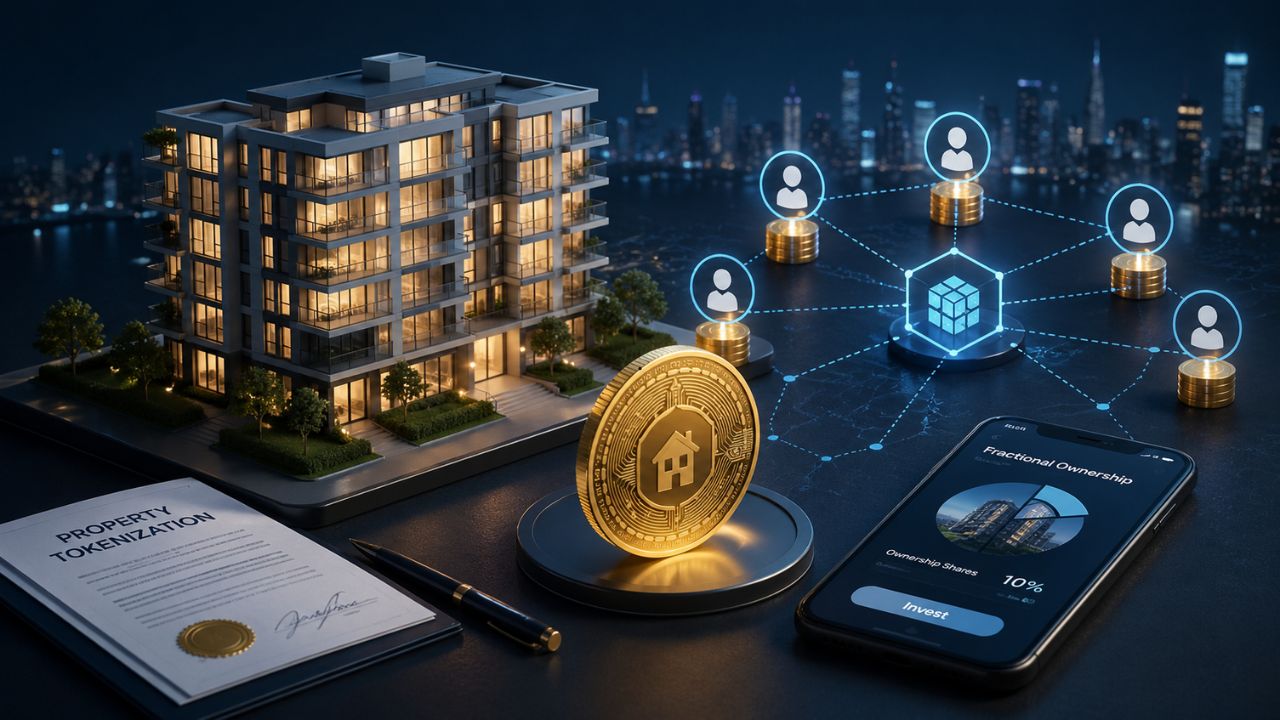
Real estate has always had that reputation of being where serious wealth gets built, but for most people, getting a seat at that table has never been easy. Prices stay high, buying takes real money, and the process can feel built for institutions long before it feels open to ordinary investors. That gap between interest and access is exactly what real estate tokenization is trying to close, which is predicted to increase in value from an estimated less than $0.3 trillion in 2024 to $4 trillion in 2035.
At a basic level, real estate tokenization involves converting the rights of property ownership into tokens on a blockchain-based system, allowing investors to purchase smaller shares to co-invest with others in a major asset. That is why tokenized real estate is being watched so closely by investors, property owners, and businesses alike. In this blog, we’ll unpack how it works, where the value is real, and where caution still matters.
Key Takeaways
- Understand how real estate tokenization works and why it is changing access to property ownership.
- See how fractional real estate ownership through tokenization lowers entry barriers across major property types.
- Learn why the real estate tokenization platforms are gaining ground as a more flexible ownership model.
What is Real Estate Tokenization & How Does It Work?
Real estate tokenization refers to the conversion of property rights into a blockchain token. This allows investors to buy into a fraction of the building, rather than the whole property. For example, if a $10 million asset is split into 10,000 tokens, each token will cost $1,000. That setup gives more people a way into blockchain real estate without the usual capital barrier. Each token represents a legally backed share, with possible returns tied to rent, appreciation, or both. In simple terms, property tokenization breaks a large real estate asset into smaller, investable parts.
How Real Estate Asset Tokenization Works:
STEP 1: Property Selection & Valuation – Asset is assessed, priced, and verified.
STEP 2: Legal Structuring – SPV holds property for token issuance.
STEP 3: Token Creation – Smart contracts mint ownership-linked digital tokens.
STEP 4: Regulatory Approval – Offering follows applicable securities requirements.
STEP 5: Investor Offering – Tokens list on approved investment platforms.
STEP 6: Ongoing Management – Income gets distributed to token holders.
The Limitations of Traditional Property Ownership
Traditional real estate has created generational wealth for decades, but the model has rarely worked well for people without serious capital ready to deploy. That frustration is a big part of what’s pushing people toward real estate tokenization services. Here are some reasons why:
High Entry Costs
The purchase of even a small investment property can be expensive and prevent many people from starting.
Slow Exit Cycles
Unlike stocks that can be sold in seconds, a property can sit on the market for months, leaving capital tied up with very little flexibility.
Geographic Limits
Owning property across different cities or countries brings legal complexity, tax issues, and currency risk that many investors cannot easily manage.
Information Gaps
Property records, ownership history, and valuation details often sit in separate systems, which makes it harder to verify an asset quickly and confidently.
How Real Estate Tokenization Supports Fractional Ownership
Fractional real estate ownership is not a new idea, but tokenization has made it far more practical, traceable, and accessible than older co-ownership models. By turning a property’s value into blockchain-based tokens, multiple investors can hold defined shares in the same asset without the usual confusion that often comes with traditional shared ownership. That makes entry easier for smaller investors while also giving the ownership structure a clearer digital record. In simple terms:
- Each token reflects a defined ownership share
- Smart contracts handle income distribution automatically
- Investors can enter with smaller amounts
- Ownership records stay visible on-chain
- Secondary trading can improve liquidity
Major Property Types Leading Real Estate Asset Tokenization
Not every asset class has welcomed outside capital easily, and real estate has been one of the slowest to change. That is starting to shift, and it is showing up most clearly in property types where the income is predictable, the asset values are high, and breaking ownership into smaller pieces does not dilute what makes the investment worth holding in the first place. Here is where that shift is taking shape.
Residential Properties
Single-family rentals and apartment investments remain popular in tokenized markets because investors can clearly track rental performance and ownership value. As more owners focus on ways to stand out in the real estate market, digitally shared property ownership is becoming easier for smaller investors to access.
Commercial Real Estate
Office buildings, retail spaces, and leased business assets suit tokenization because they carry high values and predictable income. Fractional ownership gives smaller investors a way into assets that traditional ownership usually keeps out of reach.
Hospitality Assets
Hotels, serviced apartments and vacation rentals are good fits because there’s a strong link between cash flow and occupancy. That gives shared ownership a clearer structure and makes performance easier for token holders to track.
Industrial & Logistics Properties
Warehouses, distribution, and logistics centres have become more attractive with the growth of e-commerce, but are still costly. Blockchain real estate makes ownership in this capital-heavy segment more reachable through smaller investment portions.
Development & Pre-Construction Projects
Developers are also using tokenization before completion, dividing early-stage ownership into smaller entry points. That gives investors earlier access while helping projects raise capital beyond the usual circle of lenders and large backers.
Practical Benefits of Real Estate Tokenization for Key Stakeholders
Real estate tokenization genuinely changes who gets to participate in property markets and how much friction everyone involved has to deal with, whether you’re putting money in, listing an asset, or building one.
For Investors
- Buy property shares for just hundreds of dollars.
- Trade tokens more flexibly than traditional property allows.
- Hold assets across cities and countries easily.
- Receive rental income directly via smart contracts.
For Owners
- Raise capital without selling the entire property.
- Reach a global pool of retail investors.
- Cut out brokers and reduce transaction costs.
- Retain partial ownership while monetizing asset value.
For Developers
- Fund projects faster through fractional token sales.
- Attract smaller investors that traditional financing ignores.
- Reduce dependence on a single large lender.
- Launch fundraising before construction even fully begins.
Future of Property Ownership Through Real Estate Tokenization
For most people, owning part of a commercial building or a high-value home has never felt like a real option. The old model was simple and brutal: either you had the capital, or you stayed out. Real estate tokenization begins to change that by splitting ownership into smaller, legally backed portions. Deloitte predicts that the size of the tokenized real estate market will increase from less than $0.3 trillion in 2024 to $4 trillion in 2035, so this is likely to become more than a curiosity.
What stands out is how normal this may start to feel. Whether you have followed this space for years or are only now looking at what property tokenization means, the bigger change is not just technical. It is about access, participation, and who gets to own a share of real estate in the first place. That circle of who gets to own real estate is beginning to widen.
Conclusion
Property ownership has always been easier for people who had the capital, access, and confidence to enter early, while everyone else stayed on the outside looking in. RWA tokenization for assets like real estate starts to change that pattern by making ownership easier to divide, easier to access, and easier to understand across real, income-producing assets. What once required full control of a property can now be approached through smaller, legally backed portions.
Seen as a whole, tokenized real estate matters because it changes who can participate in property ownership and how real assets can be opened to a wider market. As this space moves from early interest into real execution, businesses will need the right structure, technology, and launch strategy to do it well. For those looking to enter with a clearer plan and stronger market readiness, connect with INORU’s RWA tokenization services for a practical path for all your asset tokenization needs.