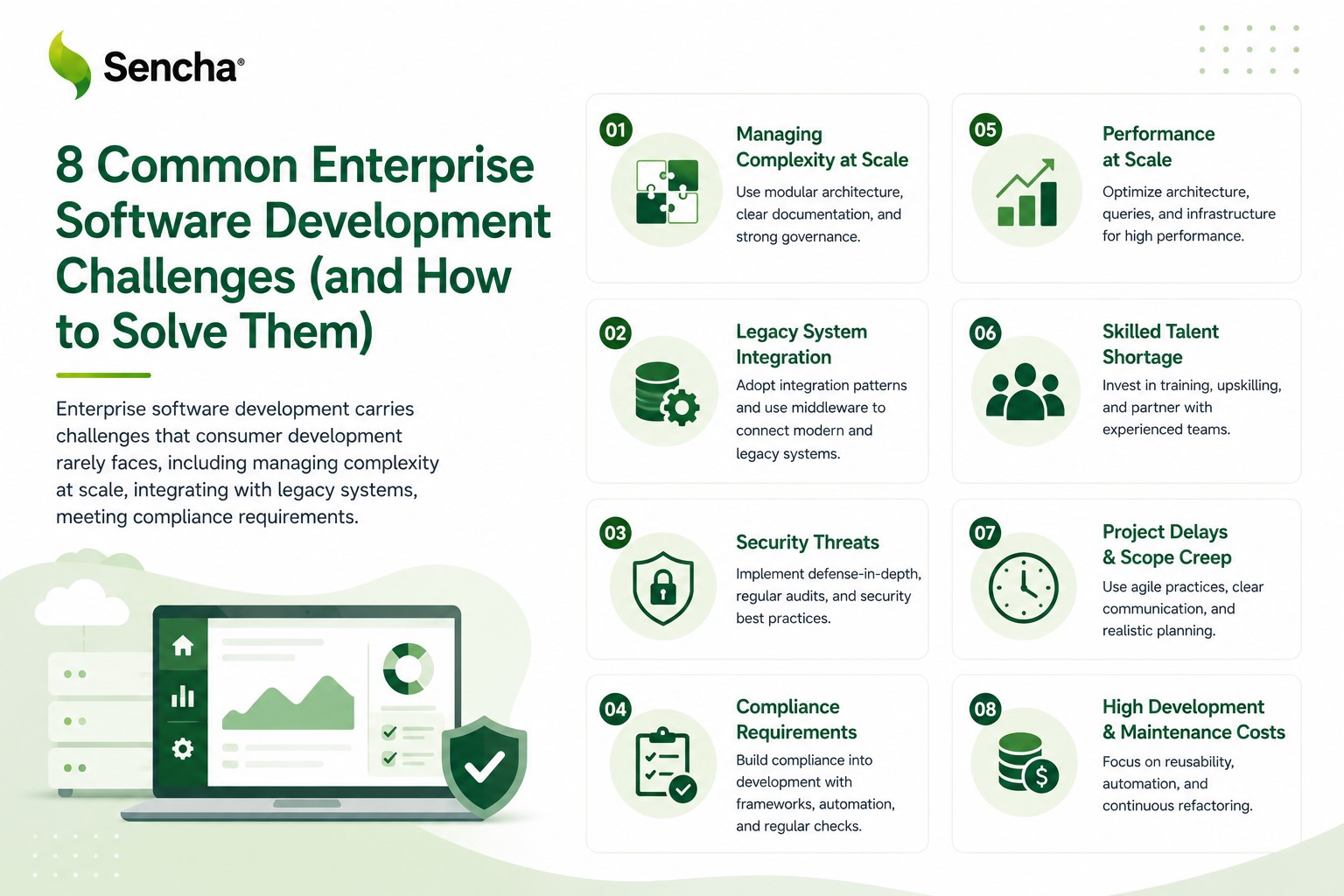
Enterprise software development carries challenges that consumer development rarely faces, including managing complexity at scale, integrating with legacy systems, meeting compliance requirements, controlling technical debt, and delivering applications that remain maintainable for many years. This guide covers eight challenges that consistently appear in enterprise development projects, with practical solutions and the role that application development software, software development platforms, and enterprise application development services play in solving each one. Each challenge includes the underlying problem, the most common symptoms, and concrete approaches that have worked for enterprise teams.
Key Takeaways
- Enterprise software development operates under constraints that consumer development rarely faces, including compliance, integration, and multi-year lifecycle requirements.
- Managing complexity at scale is the most common challenge, with structured architecture, component standardization, and disciplined documentation as the primary solutions.
- Legacy system integration consumes significant resources in many enterprise projects and requires explicit planning rather than improvisation.
- Security and compliance are non-negotiable requirements that compound over an application’s lifecycle and need to be built in from the start.
- Technical debt accumulates faster than teams expect and requires both prevention and remediation strategies to manage.
- Software development platforms with comprehensive component libraries reduce the assembly work that scales poorly across enterprise teams.
- Choosing tools and frameworks deliberately, with explicit consideration of long-term maintenance cost, prevents many challenges before they appear.
Enterprise software development operates under constraints that consumer development rarely faces. Applications often serve thousands of concurrent users, handle very large datasets in real time, integrate with many existing systems, meet strict compliance requirements, and remain maintainable for many years. The decisions made early in development affect cost and capability throughout the application’s lifecycle, and the mistakes are expensive to correct after release.
The challenges below appear consistently in enterprise development projects across industries and team sizes. Each is paired with practical solutions that have worked for enterprise teams, along with notes on where application development software, software development platforms, and enterprise application development services fit into the solution. The challenges are not independent: solving one often makes others easier, and ignoring one often makes others worse. Most enterprise development teams face several of these simultaneously, and progress comes from addressing them as a connected system rather than as separate problems.
The 8 Common Challenges and Their Solutions
Challenge 1: Managing complexity at enterprise scale
The problem
Enterprise applications grow large enough that no single developer understands the entire system. Components depend on other components, business logic spreads across modules, and the cumulative complexity makes changes risky and expensive. Symptoms include long onboarding for new developers, frequent regression bugs when features change, and teams becoming reluctant to refactor because the risk of breaking unrelated functionality is too high. Complexity that is invisible in a small application becomes the dominant cost in an enterprise one.
The solution
Manage complexity through structured architecture, component standardization, and disciplined documentation. Use a layered architecture that separates UI, business logic, and data access into distinct concerns that teams can work on independently. Standardize on a component library so the UI patterns used across the application are consistent and predictable, which both reduces the cognitive load on developers and makes refactoring safer. Document architectural decisions and the reasoning behind them, so future maintainers understand why specific approaches were chosen. Software development platforms that include comprehensive component libraries, such as Ext JS with its 140+ pre-built components, reduce a significant portion of the complexity that teams would otherwise have to manage themselves through library assembly.
Challenge 2: Integrating with legacy systems
The problem
Enterprise applications rarely exist in isolation. They integrate with existing databases, identity systems, ERPs, CRMs, custom internal tools, and applications built years or decades ago. Each integration has its own protocols, data formats, authentication requirements, and reliability characteristics. Symptoms include integration work consuming a much larger share of development time than expected, undocumented behavior in legacy systems producing surprising failures, and integration testing becoming the primary bottleneck in delivery cycles. Many enterprise projects underestimate integration cost by a wide margin.
The solution
Plan integration explicitly rather than treating it as a residual task. Inventory the systems the application needs to integrate with early, document the integration approach for each one, and assign clear ownership for keeping the documentation current as integrations evolve. Use proven data binding architectures that handle backend integration cleanly: Ext JS stores and proxies, Angular’s RxJS Observables, and similar patterns reduce the boilerplate that integration would otherwise require. For complex integrations, build an abstraction layer that isolates the application from the specifics of each legacy system, so changes in those systems do not propagate throughout the application code. Enterprise application development services with experience in the target legacy systems often produce better integration outcomes than teams attempting unfamiliar integrations for the first time.
Challenge 3: Meeting security and compliance requirements
The problem
Enterprise applications operate under security and compliance requirements that consumer applications can ignore. Financial services applications must meet SOX and other regulatory requirements. Healthcare applications need HIPAA compliance. Many applications must meet WCAG 2.2 accessibility standards. Security vulnerabilities have direct business consequences including data breaches, regulatory fines, and lost customer trust. Symptoms include long security review cycles delaying releases, accessibility retrofits costing more than the original development, and dependency vulnerabilities producing emergency patches at unpredictable intervals.
The solution
Build security and compliance into the development process from day one rather than retrofitting them later. Choose frameworks with strong security postures, including Content Security Policy compatibility, built-in protection against common attacks such as cross-site scripting, and predictable security update cycles. Minimize the third-party dependency footprint, since each transitive dependency adds attack surface. Build WCAG 2.2 accessibility into components from the start: frameworks with accessibility built into their components, including the Ext JS Modern toolkit, reduce the compliance work compared to frameworks where accessibility is the application’s responsibility per component. Run automated security and accessibility tests in the CI pipeline so regressions are caught immediately rather than during release reviews.
Challenge 4: Performance at scale
The problem
Enterprise applications often handle large datasets and many concurrent users from initial release. Performance optimizations that work for small applications fail when the data volumes grow. Symptoms include grids and lists that freeze the browser with realistic data volumes, dashboards that take many seconds to render, and applications that work in development on small samples but break in production with real data. Performance optimization after the fact is significantly more expensive than designing for performance from the start.
The solution
Design for performance from day one rather than treating it as an optimization phase. Build the data layer for the data volumes the application will actually see in production, including server-side filtering, sorting, and pagination that scale to the realistic workload. Use virtualization for any list, table, or grid that may display many rows: rendering only visible items keeps performance steady regardless of dataset size. Frameworks with native virtualization built into their data components, such as Ext JS, remove the implementation burden compared to frameworks where virtualization depends on third-party libraries. Implement performance monitoring from first deployment, with defined budgets for key user workflows, and run automated performance tests in CI so regressions are caught immediately.
Challenge 5: Controlling technical debt over multi-year lifecycles
The problem
Enterprise applications run for years, sometimes a decade or more, and technical debt accumulates throughout. Quick fixes harden into permanent architecture. Dependencies fall behind. Framework versions become unsupported. Symptoms include applications stuck on old framework versions because upgrade work is too expensive, code that no one wants to touch because changes break things unpredictably, and growing portions of the team’s capacity going to maintenance rather than new features. The compounding effect makes early decisions extraordinarily expensive in retrospect.
The solution
Manage technical debt through both prevention and remediation. Prevent debt by choosing frameworks with strong backward compatibility and predictable release cadences, since frameworks with frequent breaking changes generate debt automatically over time. Ext JS maintains backward compatibility across major versions and provides the Sencha Upgrade Adviser for migration support, which keeps the upgrade path manageable rather than requiring full rewrites. Remediate existing debt through scheduled refactoring time rather than treating it as an emergency. Build comprehensive automated test suites so refactoring is safe enough to do regularly. Track technical debt explicitly: maintain a list of known issues with their cost and risk, so debt becomes visible rather than accumulating invisibly until it becomes urgent.
Challenge 6: Closing the talent and skills gap
The problem
Enterprise development requires specialized skills that are hard to find and retain. Senior developers with experience in specific frameworks, integration patterns, and enterprise scale are in short supply. New hires take months to become productive on complex enterprise applications. Symptoms include long hiring cycles for specialized roles, key knowledge concentrated in a few senior developers whose departures create immediate gaps, and slower delivery during the periods when new team members are ramping up. The talent gap is not a problem that resolves on its own; it requires deliberate strategies.
The solution
Combine internal development with deliberate use of external resources. Standardize on frameworks and tools with broad availability so hiring is not constrained to rare specialists. Invest in onboarding processes that bring new developers up to speed quickly, including standardized development environments, comprehensive documentation, and mentorship from senior team members. Use external development support for projects that require capabilities the internal team lacks. Investing in custom web development early helps establish strong patterns the internal team can maintain long term. For framework-specific expertise, vendor training programs such as Sencha University provide structured paths for teams adopting new frameworks. Treat documentation and code clarity as deliverables, not optional extras, so knowledge stays accessible when team composition changes.
Challenge 7: Choosing tools and platforms deliberately
The problem
Enterprise teams often choose tools and frameworks reactively rather than deliberately. A senior developer’s preference becomes the team standard. A pilot project’s framework becomes the enterprise framework. Tools are added to solve specific problems without considering how they will fit together at scale. Symptoms include incompatible tool choices across teams, integration friction between tools that were never designed to work together, and accumulated tooling complexity that slows development without providing proportional benefit. Tool choices that seemed obvious in the moment look poor in retrospect once their long-term consequences become visible.
The solution
Make tool and platform decisions deliberately, with explicit evaluation criteria and long-term consequences as primary factors. Application development software should be evaluated against the enterprise’s specific requirements, not on general popularity, including the depth of components included, the quality of surrounding tooling, the platform’s track record on backward compatibility, and the total cost of ownership across the application’s lifecycle. Document the rationale for tool and platform choices so future decisions can build on the existing standards rather than reinventing them. Periodically review whether existing standards still fit the organization’s needs, since the tooling landscape evolves and decisions made years ago may not match current requirements. Avoid adopting new tools without explicit consideration of how they fit with existing ones.
Challenge 8: Maintaining velocity as the application grows
The problem
Development velocity often declines as enterprise applications grow. Features that took weeks in the first year take months in the third year. Bug fixes that were straightforward early in development become risky as the application’s complexity increases. Symptoms include declining sprint completion rates, growing time between commits and production releases, and teams spending increasing portions of their capacity on coordination rather than development. The velocity decline is not inevitable, but reversing it requires deliberate effort.
The solution
Maintain velocity through architectural discipline, component standardization, and process improvement. Architectural discipline means continuing to apply the patterns that worked at small scale even as the application grows, rather than letting expedient shortcuts accumulate. Component standardization means using the same well-tested components across the application rather than rebuilding similar patterns repeatedly: this is where comprehensive frameworks such as Ext JS provide ongoing leverage, because the 140+ built-in components remove repetitive component work that would otherwise consume development time. Process improvement means continuously refining the development workflow as the application grows, including automated testing that scales, code review processes that maintain quality without blocking velocity, and deployment pipelines that handle increasing complexity. Velocity at scale is the result of many small decisions, not a single big one.
How the Challenges Connect
The eight challenges are not independent problems. They interact, and the choices made for one affect the others. Recognizing the connections helps teams address them as a coordinated system rather than as isolated problems.
Complexity at scale (Challenge 1) and technical debt (Challenge 5) are deeply linked. Unmanaged complexity produces debt, and accumulating debt increases complexity. The same architectural discipline that controls complexity also limits debt. Legacy integration (Challenge 2) often produces both complexity and debt when handled poorly, which is why explicit integration planning pays dividends across multiple challenges.
Security and compliance (Challenge 3) and performance (Challenge 4) often share solutions even though they seem unrelated. Both benefit from frameworks with strong defaults, both require monitoring from day one rather than retrofitting later, and both grow significantly more expensive when addressed reactively rather than proactively. Component standardization, which solves Challenge 1, also improves both security (fewer dependencies to audit) and performance (battle-tested optimization built into components).
Talent gaps (Challenge 6), tool choice (Challenge 7), and velocity (Challenge 8) form their own cluster. Poor tool choices make hiring harder because they constrain the talent pool. Talent gaps slow velocity because work concentrates on a few people. Velocity problems put pressure on tool decisions, which often produces worse choices made under time pressure. The cluster is reinforcing in both directions: improving any one tends to improve the others, while letting any one slide tends to make the others worse over time.
Solving the Challenges Together
Addressing the challenges as a connected system requires a few foundational practices that produce benefits across multiple challenges at once.
Choose comprehensive application development software
Application development software with built-in component libraries, strong backward compatibility, and integrated tooling addresses multiple challenges simultaneously. Comprehensive component libraries reduce complexity (Challenge 1) by removing the assembly work that scales poorly. They reduce technical debt (Challenge 5) by minimizing the third-party dependencies that accumulate over time. They support velocity (Challenge 8) by providing tested components for the patterns enterprise applications repeatedly need. We built Ext JS specifically for this combination of needs, with the data grids, charts, forms, and other components that enterprise applications would otherwise have to assemble from many separate libraries.
Choose software development platforms with long-term support
Software development platforms with strong backward compatibility, predictable release cycles, and committed long-term support reduce technical debt (Challenge 5) and tooling complexity (Challenge 7). They also support talent retention (Challenge 6) by providing stable platforms that developers can build deep expertise in over years. Platforms that change frequently or face uncertain futures generate debt automatically, while stable platforms let teams build durable knowledge that compounds in value.
Use enterprise application development services strategically
Enterprise application development services fill capability gaps that internal teams cannot cover, particularly for initial implementations in unfamiliar domains or technologies. Used well, they accelerate delivery (Challenge 8), bridge talent gaps (Challenge 6), and establish patterns the internal team can then maintain. Used poorly, they create dependencies and knowledge silos that produce worse outcomes than building internal capability would have. The pattern that works best is using services for specific high-leverage problems while building internal capability for ongoing maintenance.
Build automation into the development workflow
Automation across testing, security scanning, accessibility validation, and performance monitoring catches problems early when fixing them is cheap. Automation supports security and compliance (Challenge 3) by catching regressions immediately, supports performance (Challenge 4) by detecting degradation as it happens, and supports velocity (Challenge 8) by removing manual work from delivery cycles. Most enterprise teams under-invest in automation early in projects and pay the cost throughout the application’s lifecycle.
Conclusion
Enterprise software development challenges are real, but they are also predictable. The same challenges appear across industries, team sizes, and application types because they emerge from the underlying nature of enterprise applications: large scale, long lifecycles, strict requirements, and complex integration with existing systems. Teams that recognize the challenges early and address them deliberately produce dramatically better outcomes than teams that confront each challenge reactively as it appears.
The solutions in this guide work best when applied together as a coordinated system. Comprehensive application development software addresses complexity, debt, and velocity simultaneously. Software development platforms with long-term support reduce debt while supporting talent retention. Enterprise application development services bridge capability gaps strategically. Automation catches problems early across multiple dimensions. Combining these approaches produces enterprise applications that remain maintainable, secure, and valuable across the multi-year lifecycles that enterprise applications typically run.
Teams ready to evaluate a comprehensive framework that addresses many of these challenges natively can start a free Ext JS trial and assess the framework against their own enterprise development requirements.
Frequently Asked Questions
What are the most common challenges in enterprise software development?
Eight challenges consistently appear in enterprise software development across industries: managing complexity at scale, integrating with legacy systems, meeting security and compliance requirements, performance at enterprise scale, controlling technical debt over multi-year lifecycles, closing the talent and skills gap, choosing tools and platforms deliberately, and maintaining velocity as the application grows. These challenges are not independent; they interact, and the choices made for one affect the others. The most effective teams address them as a coordinated system rather than as isolated problems.
How does enterprise software development differ from typical software development?
Enterprise software development operates under constraints that typical software development rarely faces. Applications often serve thousands of concurrent users, handle very large datasets in real time, integrate with many existing systems, meet strict compliance requirements, and remain maintainable for many years. The user base is also different: consumer applications can force users to adapt to new interfaces, while enterprise applications must accommodate existing business processes and user training investments. These constraints shape every development decision, from framework selection to deployment processes.
What role does application development software play in solving these challenges?
Application development software is the foundation that the team builds on, and the choice affects how easily teams can address the eight common challenges. Software with comprehensive component libraries reduces complexity by removing assembly work. Software with strong backward compatibility reduces technical debt. Software with built-in security and accessibility supports compliance. Software with deep documentation and training reduces talent ramp time. The right application development software addresses multiple challenges simultaneously, while the wrong choice can make many of them worse.
How important are software development platforms for enterprise applications?
Software development platforms are critical for enterprise applications because they determine the tooling foundation the team works with across the application’s lifecycle. Platforms with strong backward compatibility, predictable release cycles, and committed long-term support reduce technical debt and tooling complexity, while platforms that change frequently or face uncertain futures generate debt automatically. The platform choice is one of the highest-leverage decisions in enterprise development because it affects multiple challenges simultaneously and is expensive to change after the application is established.
When should we use enterprise application development services?
Enterprise application development services are most useful for bridging capability gaps the internal team cannot cover, particularly for initial implementations in unfamiliar domains or technologies. Common scenarios include rolling out a new framework across multiple teams, building a high-complexity initial implementation that establishes patterns the internal team will maintain, or accelerating delivery during a critical project window. The pattern that works best is using services for specific high-leverage problems while building internal capability for ongoing maintenance, rather than depending on external services indefinitely.
How can we prevent technical debt in enterprise applications?
Prevent technical debt through deliberate platform choices, architectural discipline, and ongoing maintenance investment. Choose frameworks with strong backward compatibility and predictable release cadences, since frameworks with frequent breaking changes generate debt automatically. Apply architectural patterns consistently even under delivery pressure, since shortcuts accumulate into structural debt. Allocate maintenance capacity in every development cycle so debt does not require emergency remediation later. Track debt explicitly with a list of known issues, costs, and risks, so it becomes visible rather than accumulating invisibly.
What is the biggest mistake enterprises make in software development?
The biggest mistake is underestimating the long-term consequences of early decisions. Framework choice, architecture patterns, and tooling decisions made in the first few months affect cost and capability throughout the application’s lifecycle, which often runs many years. Teams optimize for delivery speed in the first year and accept choices that produce expensive debt across the remaining lifecycle. Treating these early decisions as long-term investments rather than expedient choices is the single most impactful change most teams could make.
How do we handle legacy system integration?
Plan integration explicitly as a first-class concern rather than as a residual task. Inventory the legacy systems the application must integrate with early in the project. Document the integration approach for each system, including authentication, data formats, error handling, and reliability characteristics. Build abstraction layers that isolate the application from legacy specifics, so changes in the legacy systems do not propagate throughout the application code. Allocate explicit budget for integration work, since most enterprise projects underestimate integration cost significantly. For unfamiliar legacy systems, enterprise application development services with experience in those specific systems often produce better outcomes than internal teams learning the systems for the first time.
How do we balance new features with technical debt remediation?
Allocate dedicated capacity for debt remediation in every development cycle rather than treating it as something done when there is spare time, because there is never spare time. A common pattern is allocating 15 to 20 percent of capacity to maintenance and debt remediation, which keeps debt from compounding while still delivering meaningful new features. Track debt explicitly so the work is visible and prioritized rather than buried. Build automated test suites so debt remediation is safe enough to do regularly without breaking unrelated functionality. The goal is steady reduction of debt over time, not a single big cleanup that never quite happens.
Which framework is best for enterprise software development?
The best framework depends on the application’s profile and the team’s existing capabilities, but several patterns consistently produce good outcomes. For data-intensive enterprise applications with multi-year lifecycles, Ext JS provides the strongest combination of comprehensive components, performance, backward compatibility, and integrated tooling. For large structured teams that benefit from opinionated architecture, Angular suits the work well. For consumer-facing applications and content-driven sites, React with Next.js usually scores better. The right choice depends on which of the eight common challenges the project will face most intensely, since different frameworks address different challenges better than others.