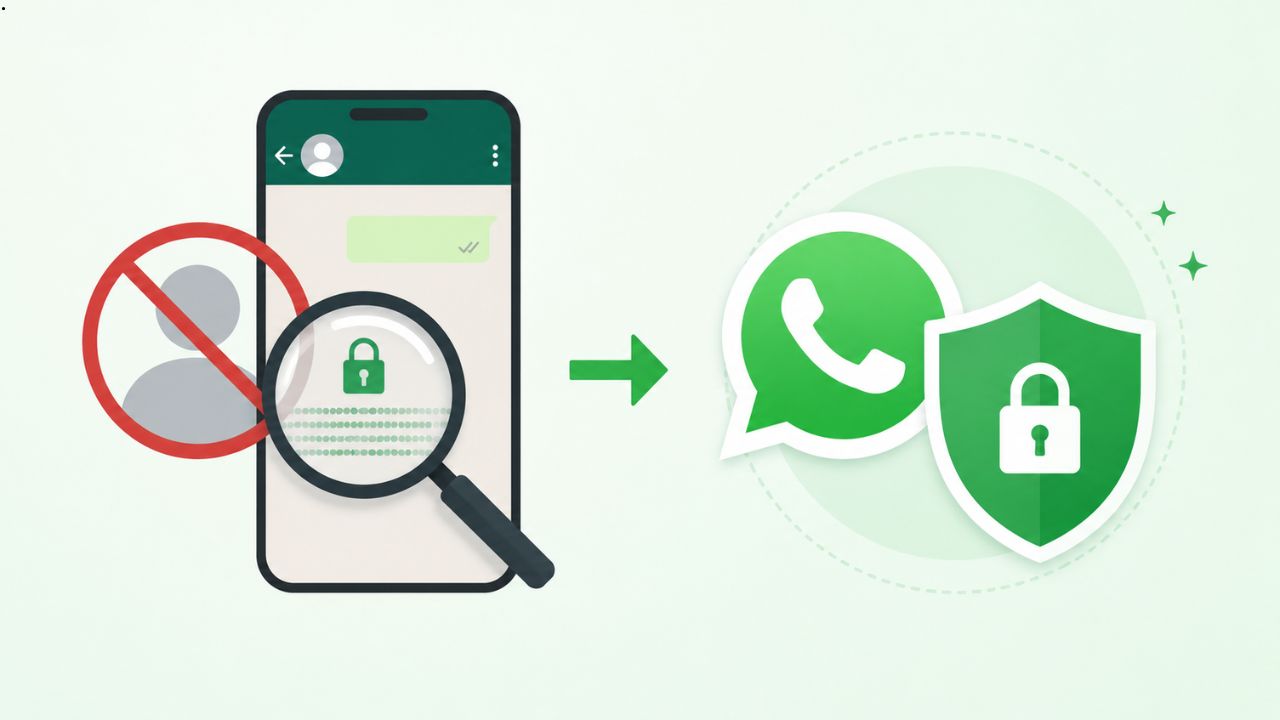
For a while, WhatsApp users had stumbled upon a surprisingly reliable way to find out if someone had blocked them. It had nothing to do with guessing or waiting around. It came from a small behavior inside the encryption verification feature. But that door is now closed. WhatsApp has patched it, and the fix rolled out to everyone without any official announcement.
Here is what happened, how the trick worked, and what you can still look for if you think someone has blocked you.
Table of Contents
How the Trick Actually Worked
WhatsApp uses end-to-end encryption for all messages, and as the app keeps growing with features like the Meta AI side chat, its backend is only getting more complex. This means only you and the person you are talking to can read what is sent. To build trust in this system, WhatsApp gives users the option to verify encryption with a contact.
When you open a chat, go to the contact info, and run the automatic encryption check, it normally passes without any problems. However, people noticed something interesting. When a contact had blocked them, that same check would fail. Instead of completing automatically, it would ask the user to verify manually instead.
This was not an official feature. WhatsApp never advertised it. But it worked consistently, and many users started relying on it as their go-to method for confirming a block.
Why This Was Technically a Bug
It is worth understanding that blocking someone on WhatsApp does not actually break the encryption in a chat. The messages are still protected. The encryption code is still there.
The real issue was with the automatic verification process itself. When someone had blocked you, that specific process would fail and throw an error. So in a way, the trick worked because of a flaw, not a feature. The encryption was fine. The automated check just could not complete correctly under those conditions.
That gap between what was actually happening and what the feature showed is what gave users a peek into something WhatsApp probably never intended to share.
WhatsApp Fixed It Without Pushing an App Update
Here is where things get interesting. There is no new version of WhatsApp on the App Store or Google Play linked to this fix — and just like the recent WhatsApp iPad update, changes sometimes land without people even noticing. If you open your app right now, you might be on the exact same version that was installed weeks ago. But the trick no longer works.
- The fix was applied on WhatsApp’s servers, not inside the app
- It rolled out to all users at the same time, regardless of their app version
- No beta testing or staged rollout was needed
This is called a server-side update. WhatsApp made a change on its backend, and suddenly the automatic encryption check now passes even in chats where you have been blocked. The result is the same for everyone on both iOS and Android.
How Quickly WhatsApp Moved on This
The speed of the fix was genuinely surprising. WhatsApp has been pushing quiet updates lately — from animated message bubbles to backend patches like this one. The trick had been shared publicly, and within days, it stopped working. That kind of quick response to an unintended behavior shows that WhatsApp keeps a close eye on how its features are being used outside of their intended purpose.
There was never any public statement from WhatsApp about this change. No blog post, no update notes, no tweet. The fix just appeared silently, and the loophole closed just as quietly as it had been discovered.
In some ways, that silence makes sense. WhatsApp never confirmed the trick worked in the first place. So there was nothing to officially announce when it stopped working either.
What You Can Still Look for If You Think You Are Blocked
Even without this method, there are still some signs worth paying attention to. And if the tables are turned, there are also ways to unblock yourself on WhatsApp depending on the situation. None of them are guaranteed on their own, but together they can give you a clearer picture.
- Single gray checkmark that never changes: This is one of the most common signs. When a message is sent but never delivered, it stays on one gray tick. If that has been the case for days, it could mean you have been blocked.
- Calls that do not connect: If your WhatsApp calls never ring and always fail immediately, that pattern is worth noting.
- Profile photo disappears: When someone blocks you, their profile picture becomes invisible on your end.
- Status updates stop showing: You will no longer see their last seen or online status if they have blocked you.
Taken together, these signs paint a stronger picture than any single one on its own. Still, none of them are definitive. Some people turn off last seen for everyone. Some have poor connectivity. Context always matters.
This Is a Good Reminder About Unofficial Tricks
People naturally look for ways to find answers that apps do not officially provide. Whether it is checking if someone has blocked them, seen their message, or is currently online, there is always some curiosity involved — especially as WhatsApp design changes keep shifting how people interact with the app. And sometimes, a small quirk in an app’s behavior becomes a workaround that spreads widely.
But these methods are fragile. They depend on unintended behavior. As soon as a company notices, or as soon as their backend gets updated, the trick disappears. Moreover, there is no warning when that happens. One day it works, and the next day it does not.
WhatsApp has made it clear, through this fix if not through words, that it does not want users confirming blocks through unofficial side effects. That is a reasonable position. A block is a privacy choice. The person doing the blocking probably does not want the other person to know immediately and with certainty.
Final Thoughts
WhatsApp closed a loophole that many users had come to rely on. The encryption verification trick for detecting blocks no longer works, and the fix is already live for everyone. There is no update to download, no setting to change. It is simply gone.
If you were using this method, it is time to let it go. The other signs of a block are still there if you need them. But even those are not perfect, and perhaps that is how it should be.