

The market for social media growth tactics includes a wide spectrum of options, ranging from genuinely useful tools to schemes that risk account suspension or worse. Distinguishing between them isn’t always intuitive, since risky shortcuts are often marketed using the same language as legitimate strategies. A field-guide approach — learning to recognise specific warning patterns rather than relying on gut instinct — offers a more reliable way to navigate this landscape.
Category 1: Credential-Based Services
Identifying markers:
- Requests the account username and password at checkout
- Claims password access is needed to “verify” or “optimise” the account
- Offers unusually fast results compared to competitors
- Results much faster than other competing services
- The reason this type of service poses such a significant risk:
Why this category is high-risk: Why is this type of category dangerous? The delivery of login data is a violation of the terms of use in most cases without exception, and there is nothing technical about it that could make it necessary for someone else to have a password in order to provide views, likes, and followers.
It is important to learn to identify platforms which just need your username or a profile link in order to be able to grow Instagram views safely without risks.
Category 2: Engagement Pods and Reciprocal Groups
Identifying markers:
- Invitation to private groups or chats promising mutual engagement
- Expectation to like, comment on, or share others’ content in exchange for the same
- Organised according to certain niche areas or numbers of followers
Why this category is risky: The platforms have become better at detecting reciprocity patterns, since natural engagement never really occurs this way in small groups
Detection can result in reduced reach for affected posts, sometimes without clear notification of why performance has dropped.
Category 3: Bot-Driven Automation Tools
Identifying markers:
- Promises automated liking, following, and commenting at scale
- Requires granting API-level or app-level account access
- Often marketed as a “growth hacking” or “engagement automation” tool
| Warning Sign | What It Usually Means |
| “Fully automated 24/7 growth” | Behaviour patterns unlikely to resemble genuine human activity |
| “Follow/unfollow” cycling | Explicitly against most platforms’ current terms |
| Generic auto-comments | Easily recognisable as spam by users as well as platform systems |
There are very few automated bots that can emulate human behaviour on websites without being recognised; platform providers continuously improve detection systems to identify such behaviour.
Category 4: Instant Bulk Delivery Services
Identifying markers:
- Guarantees thousands of views, likes, or followers within minutes
- Pricing significantly lower than services offering gradual delivery
- No information provided about where the engagement originates
Why this category draws scrutiny: A sudden and unnatural increase in engagement is one of the easier trends to identify for algorithms used by the platforms because organic growth does not happen instantly. If content experiences an unnatural boost, it may become demoted during distribution after the trend is identified.
Category 5: Data-Harvesting “Free” Tools
Identifying markers:
- Browser extensions or apps promising free followers or views
- Requests broad permissions beyond what the stated function requires
- Monetises through data collection or ad injection rather than a visible business model
These tools frequently pose risks beyond the platform itself, since granting broad permissions can expose browsing activity, saved payment information, or other personal data unrelated to social media growth at all.
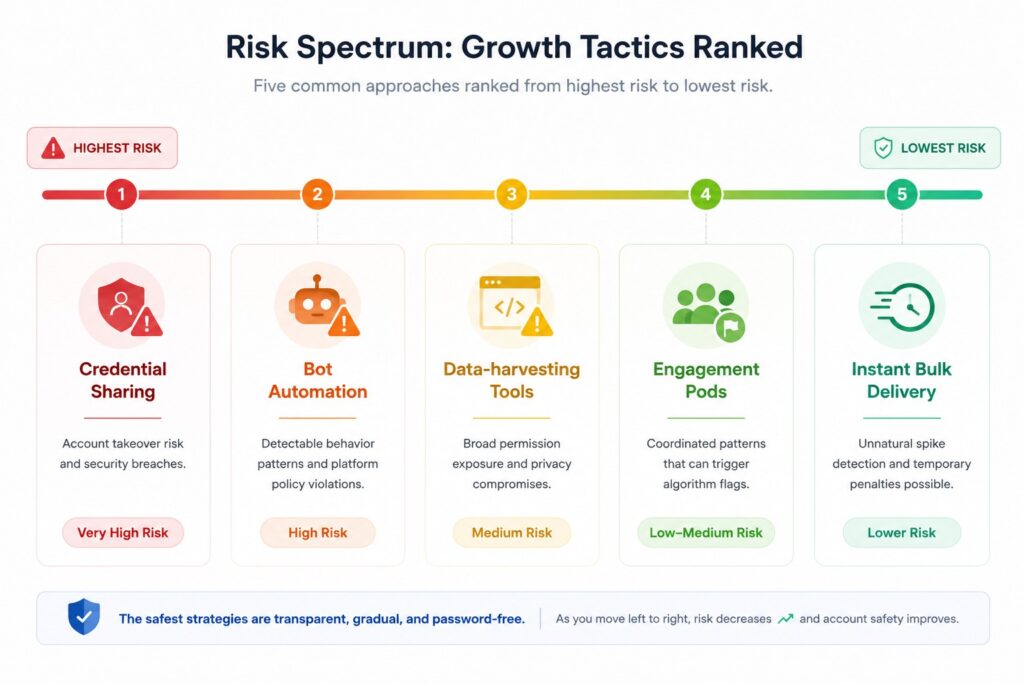
Figure 1. Risk profile of popular social media growth strategies
Sharing credentials and using bots are the high-risk strategies since they pose security and policy risks, while low-risk strategies are characterised by gradual implementation and transparency without passwords
As can be seen from the list of higher-risk strategies presented above, they have a single feature in common – it is speed rather than sustainability that matters to them.
What Legitimate Approaches Tend to Look Like
Services and tactics that fall on the safer end of the spectrum generally share a few characteristics:
- Transparent about how results are achieved, without vague claims about proprietary methods
- No requirement to share account passwords or grant broad app permissions
- Realistic, gradual delivery timelines rather than instant bulk results
- Clear, accessible refund or support policies
- Verifiable track record and reviews, as opposed to testimonials that are only posted on the vendor’s website
Instagram marketers and creators who want to organically grow Instagram views safely on their content over the long run typically take a few reliable measures, rather than focus on one short-term solution: regular content quality, format options in line with the current algorithm preferences (Reels, for example), and minimal and transparent promotion when needed, but without risky automation or purchases of views
Weighing Risk Against Reward
Every shortcut here involves a tradeoff between efficiency and risks, and the groups mentioned above differ in terms of these parameters. Sharing credentials and using automation come at high risk because these techniques may result in account security issues and even lead to account suspension. Reciprocal engagement pods and bulk-delivery services occupy a middle tier, where the immediate risk is lower but the long-term detectability and diminishing returns are significant. Data-harvesting tools introduce a different kind of risk entirely, extending beyond the social media account into broader personal data exposure.
Approaching any new tool or service with this field-guide framework — checking it against the identifying markers for each risk category before adoption — offers a more systematic way to separate genuinely useful growth resources from ones likely to cause more harm than benefit over time.