
Need to convert Bitcoin to Ethereum? Whether you’re entering the Ethereum ecosystem for its smart contracts and dApps, rebalancing a portfolio during market shifts, or exploring opportunities in decentralized finance, this guide walks you through a smooth BTC to ETH exchange — step by step, with emphasis on security, efficiency, and getting the most value from your transaction.
Step 1: Understand Why You’re Swapping
Before you initiate a swap BTC to ETH, clarify your objective so you can choose the right timing and platform. Common motivations include access to smart contracts and dApps on Ethereum, participation in DeFi protocols (including staking and NFT marketplaces), taking advantage of ETH price movement relative to BTC, and diversifying long-term holdings between Bitcoin’s store-of-value role and Ethereum’s utility-driven ecosystem.
By defining your intent, you’ll be less likely to make impulsive decisions that lead to suboptimal outcomes during a BTC to ETH conversion.
Step 2: Know Your Options to Exchange BTC to ETH
Several methods exist for exchanging BTC to ETH, and each one fits different priorities such as speed, privacy, or trade size.
Centralized exchanges
Platforms like Binance or Coinbase are often convenient for larger volumes and advanced trading tools, but they typically require sign-up, KYC verification, and may involve custodial holding periods.
Instant exchange services
Instant exchanges like Quickex are commonly used for quick swaps without registration. They focus on simplicity and reduced friction, which can be attractive for straightforward Bitcoin to Ethereum conversions.
P2P platforms
P2P services can offer flexible terms and direct peer-to-peer deals, but they bring higher counterparty risk and require extra caution to avoid scams.
Decentralized exchanges (DEXs)
DEXs can enable trust-minimized swapping via wrapped assets, which is useful for users who prioritize control over private keys. However, this route can be more complex, and understanding multichain swapping risks is important since additional fees, bridge delays, and slippage may occur depending on market conditions.
For many everyday users who prioritize speed and simplicity, instant services are often the easiest path for a BTC to ETH exchange.
Step 3: Check the Bitcoin to ETH Exchange Rate
Always verify the live rate before proceeding — don’t rely on a static number.
The BTC to ETH exchange rate is dynamic and influenced by market volatility, platform liquidity, network fees (Bitcoin transaction costs and Ethereum gas prices), overall crypto sentiment, and platform-specific spreads. Rates can also vary slightly between services, so it’s smart to compare across multiple sources.
Use real-time trackers or built-in calculators to monitor price changes, and reviewing a USD to ETH guide can also help you understand broader ETH pricing dynamics and avoid unexpected slippage before confirming the swap.
Step 4: Prepare Your Wallets
Proper wallet setup is essential for a safe Bitcoin to ETH process.
Make sure your Bitcoin wallet holds the exact amount you intend to exchange and is compatible with your chosen platform. Prepare an Ethereum wallet (hardware, software, or mobile) that can receive ETH and verify that it supports native ETH transfers.
Double-check addresses carefully. Crypto transactions are irreversible, and a single mistake can lead to permanent loss during an exchange BTC to ETH. If you’re swapping a significant amount, consider using hardware wallets or additional security layers.
Step 5: Make the Swap
Once you’re ready, execute the swap on your chosen platform:
Enter the BTC amount you want to convert, paste your verified ETH wallet address, and review the current BTC/ETH rate, estimated fees, and the final ETH amount you will receive. Then send your BTC, track the transaction using blockchain explorers, and wait for confirmation. Many swaps complete within minutes, though congestion can occasionally slow the process.
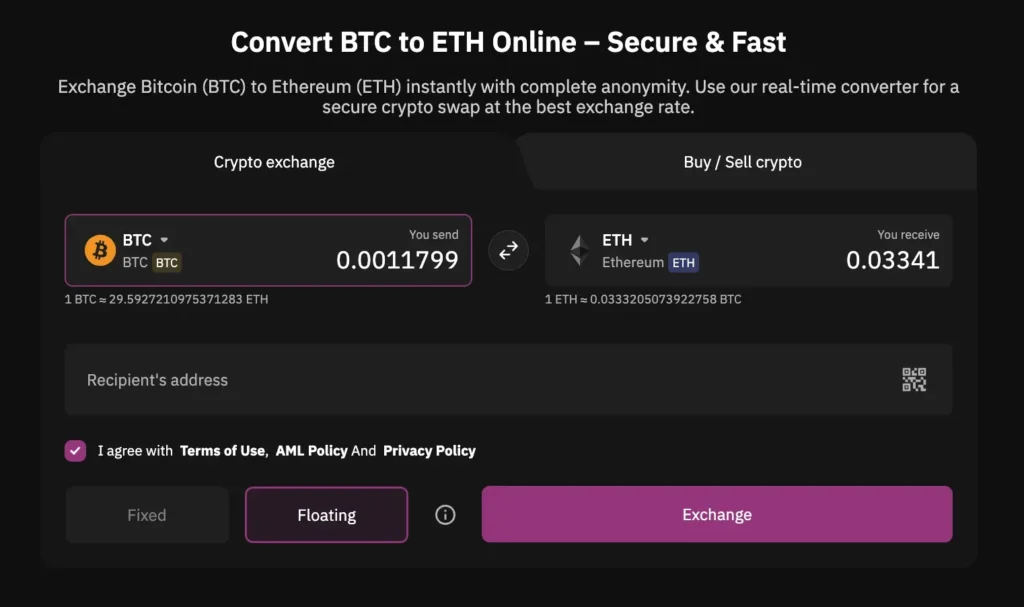
Some instant swap platforms, including Quickex, are designed to simplify this workflow by removing account creation and providing quick processing for a smoother Bitcoin-to-Ethereum experience.
Common Mistakes to Avoid
Errors can happen even to experienced users. The most common pitfalls include sending BTC to an ETH address (or the reverse), ignoring network congestion that increases fees or delays confirmations, rushing without comparing rates across platforms, failing to save transaction IDs and address details for reference, and overlooking tax or regulatory requirements in your jurisdiction.
Why Quickex Can Be a Solid Option
Quickex is often chosen by users who want a fast, straightforward BTC to ETH swap with minimal friction. It’s typically positioned around a no-account workflow, transparent rates, quick execution, and a privacy-friendly approach.
For one-time swaps, frequent conversions, or anyone prioritizing simplicity, it can be a practical option for Bitcoin to Ethereum exchanges without adding extra steps.