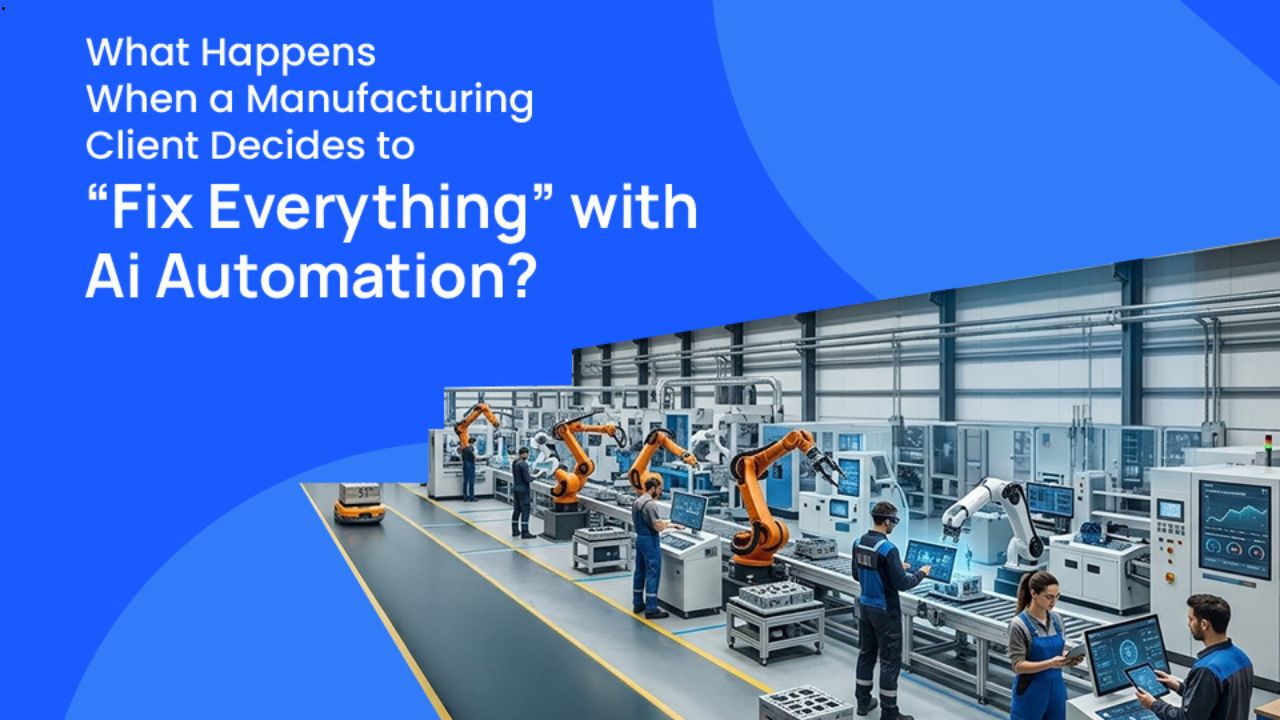
The Indian Manufacturing companies are slowly moving towards AI Automation to improve efficiency, reduce downtime and stay competitive in the market. Enterprise leaders are realising that automation is essential for the future. It can be implemented in supply chain management, predictive maintenance and quality control.
In fact, industry reports suggest:
- AI-driven manufacturing systems can reduce downtime by up to 30–50%.
- Predictive maintenance can lower maintenance costs by nearly 20–40%.
- AI-powered quality inspection systems can significantly improve defect detection accuracy.
- Global investment in AI and automation technologies is growing rapidly as manufacturers compete to modernise operations.
But there’s one growing problem many manufacturers may face. Trying to fix everything at once with AI.
Companies implement AI systems at once without a clear operational roadmap due to the excitement surrounding AI and automation. Even with the best of intentions, hurried implementation can lead to unclear workflows, disjointed systems, and low team adoption.
When the right operational issues are resolved in the right sequence, AI workflow automation truly pays off. That is what Iconflux assist manufacturing companies in implementing an Enterprise AI systemically and sustainably.
The Common Manufacturing AI Mistake
Many manufacturing firms start their AI journey with the belief that increasing automation will immediately address production problems, supply chain delays, quality issues, and operational inefficiencies.
So they try to automate Procurement, Inventory planning, Quality inspection, Production workflows, Maintenance operations, Customer support and Reporting systems. All at the same time.
AI automation, however, functions best when it is integrated with current workflows, operational priorities, and data readiness.
Without structured implementation, teams become overwhelmed, data remains disconnected, AI systems produce unreliable outputs, and operational bottlenecks increase instead of decreasing.
Because of this, enterprise AI should never be viewed as a “plug-and-play” option.
AI Automation Should Start with Operational Bottlenecks
The most stable and successful manufacturing businesses typically begin with a single, significant operational issue.
For example:
AI in Supply Chain Management
Production planning problems, inventory shortages, and delayed suppliers are common challenges for manufacturers.
Using AI supply chain management, businesses can:
- Monitor supplier activity in real time
- Predict operational disruptions
- Optimize logistics coordination
- Improve inventory forecasting
AI systems use real-time data to assist teams in making quicker operational decisions rather than manually responding to delays.
Predictive Maintenance AI Reduces Downtime
One of the biggest operational expenses in manufacturing is unexpected machine failures. This is where predictive maintenance AI adds value right away.
AI systems continuously monitor machine behaviour, equipment performance, sensor data and operational conditions.
The system notifies maintenance teams before equipment malfunctions when odd patterns emerge. This lowers maintenance costs, increases operational reliability, minimises downtime, and avoids production delays for manufacturers.
Businesses are moving toward preventive operations driven by AI automation in manufacturing instead of repairing machines after malfunctions.
AI in Quality Control Improves Production Accuracy
Another area where manufacturers are increasingly using automated AI systems is quality inspection. Conventional quality checks rely largely on manual inspection, which can result in inconsistent inspections, human error, and slower production workflows.
AI in quality control allows computer vision systems and AI models to automatically identify flaws, inconsistencies, and production problems in real time.
This allows manufacturing teams to:
- Improve product quality
- Reduce wastage
- Prevent defective shipments
- Maintain production consistency
AI for Procurement & Workflow Coordination
Procurement operations involve repetitive approvals, vendor coordination, and invoice handling. Learn how AI procurement solutions are reshaping these workflows for manufacturers.
Using AI for procurement, manufacturers can automate:
- Vendor evaluation
- Procurement approvals
- Purchase workflows
- Invoice validation
- Supplier coordination
Agentic workflows also assist AI systems in automatically coordinating tasks between departments and operational systems.
For example:
- Inventory updates trigger procurement requests.
- Procurement approvals trigger supplier communication.
- Delivery updates automatically adjust operational planning.
At this point, AI workflow automation transforms from straightforward task automation into large-scale operational coordination.
The Right Way to Implement AI Automation
Businesses that are getting the best return on investment from AI automation services are not attempting to automate everything right away.
Instead, they:
- Identify operational bottlenecks
- Prioritise high-impact workflows
- Integrate AI with existing systems
- Build scalable automation gradually
- Monitor operational outcomes continuously
The goal is not just automation. It is about creating AI-powered enterprise operations that are dependable, interconnected, and scalable.
Get Assistance From The Expert
AI is changing manufacturing processes more quickly than in the past. However, using as much automation as possible does not lead to success. It results from applying the appropriate AI systems to the appropriate operational problems.
Manufacturers will create future operations that are quicker, smarter, and more resilient if they strategically implement AI. Iconflux uses enterprise AI in manufacturing to help companies automate processes, increase visibility, and create more intelligent workflows. This includes predictive maintenance AI and AI-powered supply chain management.