
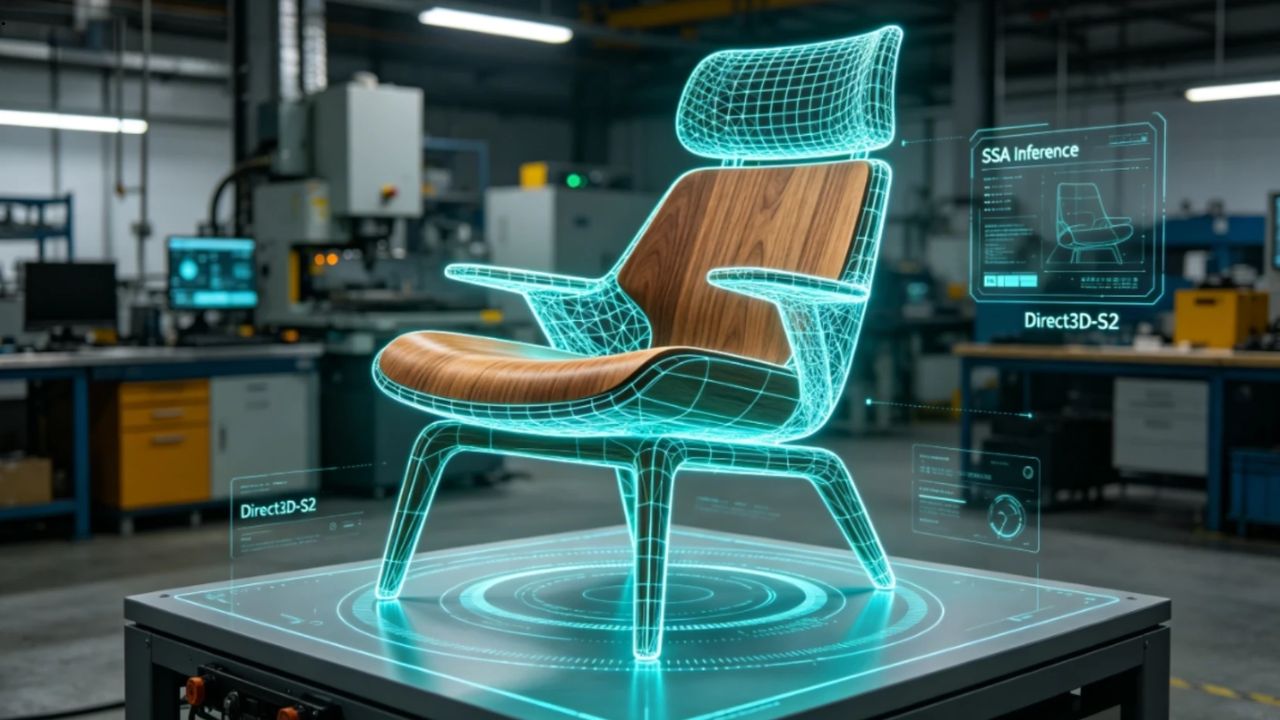
The traditional furniture manufacturing cycle is notoriously slow. From initial sketch to physical prototype, the process spans weeks, driving up labor costs and stalling ROI. Neural4D (N4D) is fundamentally shifting this landscape by utilizing a high-fidelity mesh AI workflow, allowing manufacturers to generate engineering-ready assets in seconds.
The Hidden Costs of Physical Prototyping
- Material Overhead: Prototyping complex joints results in significant material waste.
- Labor Latency: Skilled artists often spend hours on manual retopology to fix “triangle soup” generated by standard AI.
- Computational Overhead: Traditional rendering workflows often create delays that slow production pipelines, which is why many manufacturers are investing in hardware design innovation to improve speed and system efficiency.
Solving the “Non-Manifold” Crisis
A major pain point in adopting 3D printing is poor geometry. Most generators create a visual shell that is “non-manifold,” causing 3D printers to fail.
- The Watertight Standard: Neural4D ensures all outputs are watertight. The Direct3D-S2 engine produces mathematically closed geometry, ready for immediate slicing without manual hole-patching.
- Clean Topology: Unlike disorganized generators, N4D focuses on quad-dominant structures. This clean edge flow is critical for designers who need to apply subdivision surfaces to ergonomic chairs or sofas.
Scaling Production with SSA and Batch Inference
- 12x Inference Speed: The Spatial Sparse Attention (SSA) mechanism results in a 12x speed increase. This allows for batch inference, where a manufacturer can feed an entire catalog into the Neural4D API overnight.
- High-Resolution Detail: The system delivers 2048³ resolution native geometry that captures intricate wood grains and metal fasteners.
Material Fidelity and Pipeline Integration
PBR Workflows: N4D generates pure albedo textures and necessary Normal, Roughness, and Metallic maps. This ensures assets react accurately to light in any VR showroom.
Ecosystem Flexibility: Supporting native .fbx, .obj, and .stl ensures no workarounds are needed to move from design to the manufacturing floor.
Conclusion
In industrial design, the ability to iterate quickly is the only way to maintain a high ROI. By combining Deterministic output with high-fidelity mesh ai, Neural4D is not just generating models; it is engineering the future of the furniture industry.