
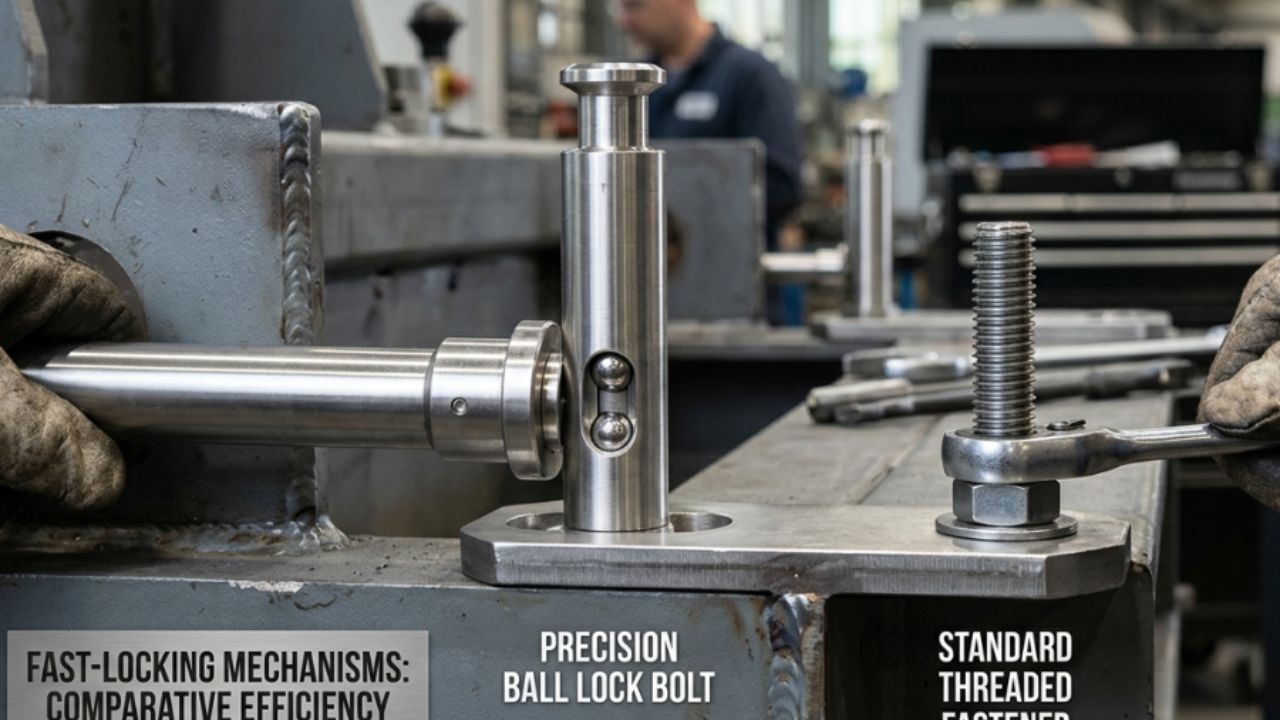
What’s the article about? Learn how ball lock bolts improve speed, accuracy, and workflow efficiency compared to traditional fasteners in welding and fixturing applications.
In modern welding setups, speed and precision are non-negotiable. No matter the work you are doing, the choice of fastening systems can affect your efficiency and accuracy. While standard fasteners have been in use for decades, it’s time to update and upgrade from tools that require multiple turns, tools, and additional time to secure and remove. This is where ball lock bolts step in as a smarter solution.
Ball lock bolts are specialized fasteners that help in quick installation. They are also good at holding power, and this changes how fabricators approach welding tasks. But how do ball lock screws and bolts outperform traditional options in high-pressure environments?
What is so Special About the Fast-Locking Mechanism of Ball Lock Bolts
The secret of the ball lock bolts lies in their spring-loaded locking mechanism. So, when the release button is pressed, the locking balls retract back into the bolt body. The release of the button causes the balls to expand and securely lock the bolt in place. While it is a simple mechanism, it creates a strong and steady connection without the need for tightening or loosening.
Let’s look at an example to better understand the mechanics. It’s as if someone fastens their seatbelt. Instead of twisting a bolt several times to secure it, a ball lock bolt clicks into place almost instantly and retains excellent holding strength. The result is faster setup times and increased workflow efficiency.
Difference Between a Ball Lock Bolt and Standard Threaded Fasteners
While both are one kind of fastening system serving the same purpose, their performance differs significantly in practical applications.
| Point of Difference | Ball Lock Bolts | Standard Threaded Fasteners |
| Installation Speed | Bolts are installed within seconds. | For the traditional fasteners, several turns are required. |
| Tool Requirement | Ball lock bolts are usually tool-free. | Traditional fasteners require wrenches or tools to get the process done. |
| Setup Time | Locks require a minimal time to be set up. | More time is required to set up a traditional fastener. |
| Repeatability | Locks come with excellent repeatability. | Fasteners have low to moderate replicability. |
| Risk of Cross-Threading | Low to absolutely none (in some cases). | Cross-threading is possible here. |
| Workflow Efficiency | Both efficiency and output are relatively high. | Efficacy and effectiveness can be said to be moderate. |
Replacing traditional bolts with ball lock screws can save both time and energy during every setup change. Over weeks and months, those time savings add up substantially.
Why Precision Matters in Fixturing Applications
Precision is one of the biggest advantages of ball lock bolts. In welding, even a small positioning error can result in poor alignment and costly rework. Ball lock bolts are made for repeatability, as they allow operators to remove and reinstall fixtures without losing alignment. Imagine producing hundreds of similar-looking components. Now, with threaded fasteners, slight variations in tightening can affect the overall positioning. This is one reason why many workshops rely on solutions from trusted ball lock bolt manufacturers such as Fixto when building modular fixturing systems.
Better Productivity Through Quick Changeovers
Manufacturing efficiency often depends on less downtime between operations. Every minute spent adjusting fixtures or changing setups is a minute not spent producing parts. Therefore, ball lock bolts come in for rapid changeovers. Operators can not only reposition clamps, but also the stops and other accessories quickly, without searching for tools or spending time tightening fasteners. Ball lock screws and bolts assist in faster fixture setup and removal, reduce production interruptions, improve operator productivity, provide greater flexibility for custom projects, and increase throughput in high-volume environments.
Choosing Quality Over Quantity
The performance of a ball lock system depends heavily on the quality, manufacturing precision, and durability. A reputable ball lock bolt manufacturer will make sure that each component is developed to tolerate, resist wear-and-tear, and deliver smooth performance under demanding conditions.
High-quality ball lock screws are generally manufactured from hardened steel and designed to withstand repeated use without compromising locking performance. This is the reason why many professionals turn to experienced ball lock bolt manufacturers like Fixto to ensure they receive precision-ridden fastening solutions, supporting productivity and accuracy.
Final Thoughts
As fabrication and manufacturing processes are becoming increasingly focused on efficiency and precision, traditional threaded fasteners are no longer the most practical solution for many applications. Ball lock bolts provide faster installation, repeatable positioning, improved workflow efficiency, and reduced downtime compared to conventional fastening methods.
Upgrade your fixturing system with precision ball lock bolts and experience faster, more accurate setups every day.